Pandemic and Environment Burden
Friday, 26/06/2020YogyakartaIka Yulia Wijayanti, S.E., M.Sc.


Regional quarantine and activity restrictions in response to the Covid-19 pandemic had a positive impact on improving air quality globally. However, the real pandemic shows the fundamental problems being faced by the environment.
For example, Jakarta had experienced a decrease in levels of carbon dioxide (CO2) sourced from motor vehicles during the period from February to March. Unfortunately, this only lasted a short time. Motor vehicle congestion with the introduction of new normal conditions will bring CO2 levels back to the normal range.
Improved air quality during the quarantine of the region is difficult to maintain for longer because the changes that occur are not structural in nature such as the shift in the use of fossil-based high energy pollutants to energy sources that are more environmentally friendly. The fall in world oil prices due to reduced demand also confirms this fact.
Even if the reduction in pollution levels can be maintained, the benefits will be far greater. Research by Marshall Burke, a Stanford University professor, shows that decreasing air pollution during regional quarantine will save humans from premature deaths due to pollution exposure in greater numbers than deaths caused by Covid-19 in China. The results of the study are expected to be an evaluation of human behavior in normal conditions that burden the environment.
During the pandemic, the movement to reduce plastic waste tends to be ruled out because of people's fear that the virus can survive on certain objects for some time. The use of masks and disposable gloves by the general public also contributes to increasing household waste.
Meanwhile, the handling of Covid-19 patients has consequences for the abundance of medical waste. The Indonesian Ministry of Environment predicts an increase in infectious waste by 30 percent compared to pre-pandemic conditions. In the midst of the lack of hazardous waste treatment facilities such as incinerators, the increase in medical waste in Indonesia has the potential to cause serious problems such as the processing of illegal medical waste.
If examined further, the mystery of the cause of the pandemic is very likely related to the current environmental crisis. Covid-19 became a global pandemic because of its rapid transmission from human to human through fluids (droplets). However, according to the World Health Organization (WHO) collaborative mission report and the Chinese Government, SARS-CoV-2 as a trigger for Covid-19 is a zoonotic virus. That is, the virus was initially transmitted from animals to humans.
The emergence of zoonotic viruses is closely related to environmental ecosystem conditions where humans and animals share a place of life. Damaged biodiversity and climate change encourage the emergence of pathogens that are increasingly strong due to the process of adaptation to environmental pressures. Meanwhile, wildlife contact with humans increases the potential for human transmission.
New normal for the environment
The experience of fighting new diseases, for a moment feeling changes in pollution levels, and the potential increase in waste that must be managed should raise awareness of the impact of the environmental crisis and what to do in the future. A number of steps need to be considered so that the environment can enjoy a better new normal.
First, changes in production and consumption behavior to achieve continuous improvement in air quality. Efforts to find environmentally friendly energy to replace high energy pollutants need to be prioritized as a long-term investment. Meanwhile, the management of industrial pollutants and the provision of public transportation to reduce the use of private vehicles is quite urgent to do.
Second, the treatment of rubbish and waste, both medical waste and household waste. The movement to reduce plastic waste must continue to be carried out by the whole community while maintaining hygiene. The data collection of people undergoing isolation at home should be followed by a mechanism for collecting household waste that is potentially dangerous if managed under normal conditions. Of course this must also be accompanied by an increase in the capacity of medical waste treatment through incinerators and other alternative processors to be able to meet the needs of waste treatment from health service facilities and household waste at risk.
Third, maintaining the health of ecosystems, among others, by allowing wild animals to remain in their habitats and maintain the biodiversity that supports them. Regulation and law enforcement related to wildlife trade and land use play an important role in minimizing the possibility of contact with humans.
________
The article was first published in the rubric "INSPIRATION FOR POLICY" SKH Kedaulatan Rakyat, Friday Edition June 26, 2020.
Managing COVID-19 Infection in Regions
Friday, 19/06/2020YogyakartaEdy Purwanto, S.P, M.Sc.
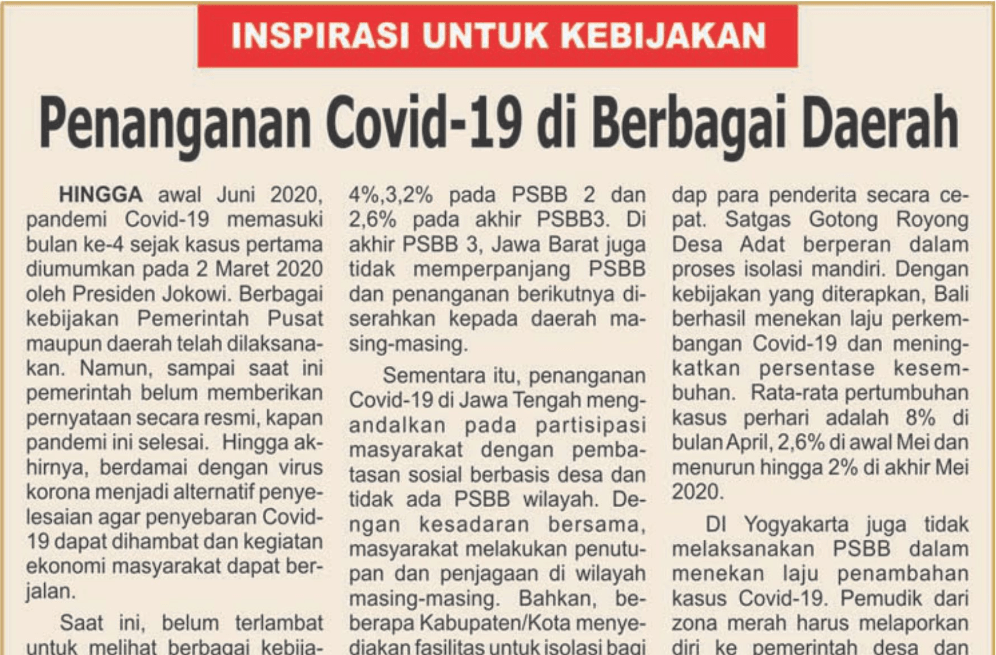
Until early June 2020, the Covid-19 pandemic entered its fourth month since the first case was announced on March 2, 2020 by President Jokowi. Various central and regional government policies have been implemented. However, until now the government has not given an official statement, when this pandemic is over. Until finally, making peace with the corona virus is an alternative solution so that the spread of Covid-19 can be inhibited and economic activities can take place.
At present, it is not too late to look at the various policies that have been implemented in each region, see the strengths and weaknesses and take lessons to continue handling pandemic cases that still continue in some areas to prepare for the second wave.
DKI Jakarta, as the initial development area of Covid-19, quickly implemented the PSBB policy since the PSBB rules were issued by the central government. DKI Jakarta applies PSBB up to 3 stages starting from April 10 to June 4 2020. From the beginning of the first PSBB to the end of the 3rd PSBB the average daily growth percentage has decreased from 5.1% then 2.1% and finally 1.6% in 3rd PSBB. With this result, the DKI Jakarta government finally adopted a transition period PSBB starting June 5, 2020. This period was used as a transition to new normal.
West Java has also implemented PSBB stages 1 to 3 in several regions such as Depok, Bogor, Bekasi and Bandung Raya. The implementation of the West Java PSBB succeeded in reducing the average daily growth rate of Covid-19 positive cases from 4%, 3.2% at PSBB 2 and 2.6% at the end of PSBB 3. At the end of PSBB 3, West Java also did not extend the PSBB and handling then handed over to their respective regions.
Meanwhile, the handling of Covid-19 in Central Java relied on community participation with village-based social restrictions and no regional PSBB. With mutual awareness, the community closes and guards in their respective regions. In fact, several Regencies / Cities provide facilities for isolation for migrants. With this policy Central Java succeeded in suppressing the average daily growth of Covid-19 from 7.5% in April, 2.9% in early May and decreased to 1.1% by the end of May 2020.
In contrast to DKI Jakarta and West Java which immediately implemented PSBB in early April, East Java implemented PSBB from 28 April to 9 June 2020. East Java PSBB was implemented in several areas including Surabaya City, Gresik Regency, and Sidoarjo Regency. This PSBB follows the Malang Raya PSBB which was implemented earlier on May 17-30, 2020. During the implementation of the PSBB in East Java, the average daily development of Covid-19 was still relatively high at 4.9% in stage I, 6.9% in stage II and 4.2% in stage III.
Although Bali does not implement PSBB, it consistently implements a policy of maintaining distance, working, studying and worshiping at home. The governor implements various policies both for patients and medical staff. In addition, officers make early detection of sufferers quickly. The Mutual Assistance Task Force in the Desa Adat plays a role in the process of self-isolation. With the policy implemented, Bali managed to suppress the rate of development of Covid-19 and increase the percentage of recovery. The average case growth per day was 8% in April, 2.6% at the beginning of May and decreased to 2% at the end of May 2020.
DI Yogyakarta also did not implement the PSBB in suppressing the rate of Covid-19 infection cases. Travelers from the red zone must report to the village government and carry out isolation for 14 days. Community participation in monitoring isolation and maintaining community compliance in their respective environments is very large. This policy succeeded in suppressing the rate of Covid-19 infection. The average percentage of case growth per day in DIY is 4.6% in April, 4.3% in early May and decreased to 1.3% at the end of May 2020.
It appears that the adoption of the PSBB shows significant success. This of course must be followed by clear law enforcement. In addition, high participation from the community showed higher results in suppressing the spread of Covid-19. The results above can be a lesson for regions that still need to implement PSBB at a later stage as well as other efforts to stop the Covid-19 infection rate in coming months.
________
The article was first published in the rubric "INSPIRATION FOR POLICY" SKH Kedaulatan Rakyat, Friday 19 June 2020 Edition.
Challenges in Early Childhood Education During Pandemic
Monday, 15/06/2020SurveyMETERHendy Puspitha Primasari, SE
The Ministry of Education and Culture requests that during the Covid-19 pandemic, Early Childhood Education (PAUD) teachers do not give students assignments of any kind. During this pandemic, children are given the freedom to play to their heart's content at home. This was conveyed by Plt. The Director of Teacher Development and Education Personnel (GTK) for Early Childhood Education, Abdoellah, in a video conference on Tuesday 31/3/2020.
Responding to the appeal, not a few PAUD teachers who then apply learning with different methods. One of them a PAUD teacher in Kulonprogo said that since the appeal from the Kulonprogo District Education Office did not provide learning material according to the Learning Implementation Plan a kind of reference for managing play activities in an effort to achieve basic competencies, he had given more assignments with learning material to nurture student’s good habit or habituation.
Nurturing student’s habit during learning at home is actually not much different from what has been applied at school. There are three themes in the material provided, namely PHBS, character education and religion. PHBS materials such as hand washing, bathing, brushing teeth, cleaning your own eating utensils. Character education materials such as helping parents, speaking politely, saying thank you, asking for help. While religious material, for example ablution, prayer, reading iqro, memorizing short letters, praying before doing activities, and so on. The material is in accordance with the curriculum currently in use, the 2013 curriculum.
The customization tasks are given every day through WA groups in the form of instructional texts, audio instructions and also sample videos. Furthermore, parents will accompany and document these activities in the form of videos or photos and then sent to the teacher as material for monitoring and assessment.
Not as easy as imagined
In practice, learning at home with habituation is not as easy as imagined. Lack of enthusiasm from children and lack of ability from parents to accompany children become challenges in the application of habituation method. A school principal in Bantul conveyed to the author, apparently not all parents can be like teachers at school. Many parents are not painstaking, children are usually even yelled at, which also has a less good effect. Maybe because of the situation and conditions, children become less enthusiastic at home so that they are bored, there are no friends, and no one motivating. Because usually in schools teachers convey learning interspersed with art, there is pat, singing, and various other creative interludes, while at home tends to be monotonous.
It is undeniable, one of the characteristics of children is that they are very easy to change their mind and change their mood (moody). That is because early childhood can not control themselves properly. Most of them have not been able to communicate smoothly and convey what is felt. This is still added to the child's learning atmosphere which suddenly changes, from what is usually done with friends with full color and creativity, now must be done alone and less attractive.
Children's moods and emotions that often change suddenly make parents feel confused and overwhelmed. Not all parents understand how to deal with children who behave not as expected. In this situation, it is not uncommon for parents to fail to form communication with children. Instead of understanding children's behavior, parents are more often angry and shouting. This certainly will be contradictory to the learning process that is being carried out.
Another challenge in applying habituation learning at home is the mindset and motivation of parents. One example of parents of students interviewed by the author states that the motivation to send children to PAUD so far has been more than just sending their children to leave work. So, when children do not go to school and only play at home, parents feel that this is the way it should be for children. Motivation and mindset like this can be one reason parents are lazy to assist children in doing the tasks given by the teacher.
Other problems experienced by teachers are related to observation and assessment. During the Covid-19 pandemic, observations can only be made by viewing videos and photos sent by students' parents. This causes the observation activities carried out by the teacher to be very limited. A kindergarten head in Bantul told the author that up to now he could not fully monitor the process of implementing learning at home. In contrast to the time at school, from morning to noon can monitor children, especially their habits such as memorization. Now with this situation the teacher cannot repeat the rote again, so that it is difficult. From the video sent, the class teacher also cannot directly see the child participating in memorizing or not.
Meanwhile, the assessment of the habituation method is an anecdotal note evaluation technique, which is to make a full observation then record all the facts, tell the situation that happened, write down what the child is doing and what the child is saying. These anecdotal notes serve as daily activity journals that make it possible to know the child's development. As a result, due to limited observations, we can be sure that anecdotal recording will not run optimally. This certainly will affect the validity of the assessment made by the teacher.
Sinergy and support
From some of the problems raised by the teacher and the conditions of the parents of the students above, it can be concluded that the implementation of learning with the habituation method does not run easily. The vital role of parents in the application of habituation methods at home has not been accompanied by sufficient understanding of how to assist and guide children according to the rules of PAUD. Parental confusion can result in children experiencing things that should not be experienced at their age. Parents' readiness to create a learning environment becomes critical. While limited observation that causes the validity of the assessment is reduced to a crucial problem experienced by the teacher.
The condition of a pandemic is indeed hard for everyone, especially for parents because the burden of thought and responsibility increases with the intensity of accompanying children in learning at home. However, it is important for parents to open up, open up insights and enthusiasm to learn how to accompany children in the learning process. It is time for parents to realize that children's learning is now fully the responsibility of parents, returning to their nature that parents are the first and foremost teacher for children.
On the other hand teachers are expected to be able to maintain two-way communication with parents and students on a regular basis. Beginning with ensuring the basic needs of children are met, then proceed with sharing tips on educating children according to the method of habituation in PAUD. The teacher must open the door wide as a consultant for parents and foster parental confidence.
The Education Office must play an active role in providing support to teachers and parents of students. Take innovative steps, provide solutions to problems that occur and consider better ways to provide education during this pandemic period.
Past the pandemic is not an easy thing for teachers, parents and children. But all depends on the will. When everything is ready, it is not impossible that PAUD From Home will be fully realized. ***
*This article was first published in:
http://news.koranbernas.id/berita/detail/tantangan-dalam-pembelajaran-paud-pada-masa-pandemi
Too Much Instant Noodles in Bansos Sembako: Health and Regulation Review
Wednesday, 10/06/2020SurveyMETERArief Gunawan, SE
For 3 months, the government disbursed social assistance (bantuan sosial/bansos), especially food supplies or sembako to affected residents of Covid-19. The contents are mostly food and beverages from large industries. How far is the alignment for farmers / fishermen?
The basic food aid program during the current pandemic still uses Permensos No.1 in 2013, not using the latest regulations from the Ministry of Coordinating Ministry of Health and Culture when viewed from the contents of the basic food aid. This is really worrying. This basic food aid program will last for 3 months, if it still uses Permensos, then this policy will not grow the economy of the people at the bottom because it only expands the production sector of the food industry. However, if seen from the contents and benefits of the food distributed at the Social Aid Center such as instant noodles, sardines, corned beef, and others, it will certainly have a negative impact on the health of the people themselves.
Facing the COVID-19 outbreak the Indonesian government has prepared a number of programs that have experienced expansion of targets since the pandemic. President Joko Widodo (Jokowi) on Tuesday (3/31/2020) announced an additional expenditure and financing for the 2020 State Budget for handling COVID-19 of Rp 405.1 trillion. The budget of Rp 405.1 trillion will be used, one of which is for the social safety net (SSN) of Rp 110 trillion.
Also special social assistance for 2.6 million people or 1.2 million families (KK) of DKI Jakarta residents and 1.6 million people or 576 thousand families of Bodetabek residents in the form of nine-basic necessities, equivalent to Rp 600,000 per month. The purpose of launching the social safety net program is to pay great attention and give top priority to maintaining the fulfillment of the basic needs of the community and increasing the purchasing power of the people at the grassroots level.
Provincial Government. East Java distributed social assistance in the form of a package of staples for its citizens affected by the Covid-19 outbreak. The package of staples was put in a large bag bearing the provincial government logo. East Java There are 6 types of staple items that are put in the bag. It contained 5 kg of premium rice, 1 liter of cooking oil, 10 packs of instant noodles, 15 eggs, 1 kilogram of sugar, and a health product package containing vitamin C, liquid hand sanitizer, and mask.
The social assistance package was packaged at the East Java Expo Building on Jalan Ahmad Yani Surabaya. A total of 206 food packages are being prepared for Surabaya residents who were affected by Covid-19 and registered in the Bansos radar system. In addition, plus 80 recipients of East Java residents who had just returned from Bali. Also last week 1,900 social assistance packages were also given to East Javanese residents who did not go home, and remained in overseas areas in the Jakarta-Bogor-Depok-Tangerang-Bekasi (Jabodetabek) area. In addition to the social assistance package, Rp 200,000 per person was given cash for three months.
In addition, President Joko Widodo has distributed social assistance in the form of food to 15 regions in Indonesia affected by the Covid-19 pandemic. The contents of the nine basic necessities include 10 kilograms of rice, 1 liter of cooking oil, and ready-to drink tea.
Of the 15 cities, the first is Surabaya, Semarang, Yogyakarta, Bandung. The assistance from the President is different from the Social Aid provided by the Ministry of Social Affairs because it comes from the community aid budget. The assistance of 10 thousand food packages to the affected Surabaya residents was received by the Mayor of Surabaya on Thursday (4/30/2020).
Assistance from the President will be allocated to other communities affected by Covid-19 who have not received any intervention from the Government, for example, people who are terminated from work relations (PHK), food vendors in schools and various workers affected by this pandemic.
In addition to this basic food assistance, East Java Provincial Government related to food there is a supplementary social assistance and coating for Non-Cash Food Assistance (BPNT), as well as food / cash assistance programs through Special Financial Assistance (BKK). For regions that are currently implementing PSBB, there are 118,758 KPM for the City of Surabaya that has received a top up from the East Java Provincial Government, which is equivalent to Rp. 5.62 billion.
Whereas for Sidoarjo Regency, there were 6,773 KPM that received the top-up which is equivalent to a total value of Rp 2 billion. And for Gresik District who will receive top up assistance, there are 3,448 KPM or equivalent to Rp 1 billion from this BPNT supplement and back up program.
Regulations on Bansos Sembako in Indonesia
So far, for the problem of disasters using regulations from the BNPB, one of them is the provision of basic food assistance during a disaster. Stated in the Regulation of the Head of the National Disaster Management Agency Number 7 of 2008 concerning Guidelines for Procedures for Providing Assistance to Fulfill Basic Needs. In Chapter 4B on food aid, food aid is provided in the form of food ingredients, or food provided by public kitchens.
The minimum standard for assistance is food in the form of 400 grams of rice per person per day or other basic foodstuffs and side dishes or food provided by the public kitchen in the form of ready meals as much as 2 meals a day. Food aid is equivalent to 2,100 kilo calories (kcal).
In addition to the above regulations there are also regulations issued by the Ministry of Social Affairs, namely the Republic of Indonesia Minister of Social Affairs Regulation No. 01 of 2013 concerning Social Assistance for Disaster Victims. In Article 4, namely direct assistance given to disaster victims referred to in Article 4 paragraph (2) letter a, in the form of clothing, food, and shelter. Food aid is direct assistance in the form of food consisting of: rice, instant noodles, packaged fish / meat, packaged soy sauce, packaged chili, packaged cooking oil, ready meals, and / or other food as needed.
Now there is a social assistance regulation on food after the issuance of the Basic Food Card Social Program issued by the Controlling Team for the Implementation of Non-Cash Social Assistance Distribution in the Office of the Coordinating Ministry for Human and Cultural Development in the form of "GENERAL GUIDELINES FOR SHOPPING THE 2020 SHOP PROGRAM". It is also arranged about the basic food aid.
This regulation contains the benefits of the nine-basic-necessity program at Rp150,000 / KPM / month. The assistance cannot be taken in cash and can only be exchanged for food that is determined for the Sembako program in e-Warong. Foodstuffs that can be purchased at e-Warong using food aid programs are: carbohydrate sources include: rice or local foodstuffs such as corn and sago. Also a source of animal protein: eggs, beef, chicken, fish or vegetable protein sources: nuts including tempeh and tofu. And also a source of vitamins and minerals: vegetables, fruits
Risks of Consuming Instant Food
Quoted from Kompas.com dated 05/22/2019, based on data from the World Instant Noodles Association, Indonesians consumed 12.54 billion servings of instant noodles throughout 2018, surpassing Japan and India. This high consumption rate raises the question, is instant noodles good for the body?
Instant noodles are generally made from basic ingredients of wheat flour, equipped with herbs containing salt, spices, and MSG. also has high calories from carbohydrate, fat, and sodium and other minerals such as manganese and iron, and is strengthened with vitamins, such as vitamins B1, B2, B3, and B9. However, excessive consumption of instant noodles has the potential to cause several diseases. High sodium content can cause an increase in blood pressure, while high carbohydrates cause the glycemic index of instant noodles to be large, thus increasing blood sugar levels. This is what motivates the appeal to limit consumption of instant noodles.
Regarding consumption of sardines or canned fish products, many say the nutritional content of canned sardines is no longer available. Although naturally, sardines are rich in vitamins and minerals. In the Indonesian Food Composition Table book from the Indonesian Nutritionists Association published in 2009, canned fish or sardines have a high enough protein value. It is said that canned sardines contain 72.7 grams, 109 kcal of energy, 19.9 grams of protein, 1.8 grams of fat, and 3.4 grams of carbohydrates. It's just that the nutritional value is said to decrease with the amount of nutrition when it is still fresh.
Although the nutritional content is similar, but canned foods are added with chemicals during the packaging process. One of the chemicals used in packaging is BPA (bisphenol-A). Although only a little, but the BPA in sardine cans can move to the food consumed. There are studies that prove the relationship between BPA intake and the risk of heart disease, type 2 diabetes mellitus, and sexual dysfunction in men. Not only BPA, but also added sugar, salt, and preservatives in canned sardines, with added sugar and salt, this can have a negative impact on conditions such as diabetes and high blood pressure.
From the information above, it can be imagined that this basic food assistance program will run for 3 months. A total of 1.7 million food-recipient families regularly consume instant food. After the pandemic, you can imagine what happened to public health. The concern is that there will be a surge in people with hypertension and other health problems. Most of them are recipients of BPJS PBI (recipient of contribution assistance), which of course will also drain health financing from the government itself.
In Case it Can Be Replaced with Fresh Fishes
If seen from economic growth, you can imagine if these instant noodles and sardines bansos are replaced with local carbohydrate foods and fresh or salted fish according to the rules of the nine-basic necessities program from the Coordinating Ministry of PMK, then production from agriculture and fisheries from Indonesian farmers and fishermen will definitely increase, and of course there is economic movement at the grassroots level (with work still following the health protocol during this pandemic).
This means that people's purchasing power also grows and develops in line with expectations. During this pandemic problems arose in farming and community fisheries business such as the distribution of agricultural products constrained by PSBB, sluggish demand, and falling prices for agricultural products during the harvest season, which resulted in farmers being hardest hit by this condition.
As an illustration, PSBB implementation has made demand for chicken, which is dominated by restaurant owners, plummeted by 30 percent, even though the production costs on the farm are fixed. The price of eggs and fish fell free. As Kontan.co.id wrote, Friday, April 24, 2020 it was stated that the fish canning industry is one of the sectors that got a blessing amid the Covid-19 pandemic. Therefore, the demand for processed products in the sector tends to increase, especially to meet the protein needs of the community. Aside from being absorbed through the export, retail and online markets, processed canned fish is used as one of the social assistance products to the community, although there are also challenges, including rising prices for cans, sauce paste and thickening flour imported as well as the reduction in raw materials for fish imported from the country which enforces lockdown.
If agricultural and fishery products from the community's own production can fill basic food staples in accordance with the PMK kemenko regulations used during this pandemic, this condition certainly will not happen again, because of course the economic growth of the community itself will grow and be maintained aspects of production for agriculture and fisheries according to expectations from the existence of this Bansos goal.
________
This article was first published in:
Let’s Follow Health Protocol Well
Tuesday, 09/06/2020YogyakartaEdy Purwanto, S.P, M.Sc.

THROUGH the Coordinating Minister for Human Development and Culture Muhadjir Effendy, the government stated that Bali, Yogya and the Riau Islands were the first pilot projects to implement the new normal protocol for economic recovery in the tourism sector which was devastated by the Corona virus pandemic.
Taking into account the plan, as citizens of Yogya, let us try to examine the development of the Covid-19 case in DIY, the national level and several regions around us. Thus we get a more complete picture of the development of Covid-19 in DIY in the context of our readiness to welcome the reopening of temple tourism in particular, and new normal life in general later.
By analyzing the data at covid19.go.id we get an update on the development of Covid-19 until the end of May 2020. The addition of positive cases per day in the last week of May at the national level was 583 cases. If expressed as a percentage of growth (addition of cases per day / number of cases up to that day) x 100%), this value is equivalent to 2.5%. Meanwhile, the percentage of recovery reached 25.2%.
Unlike DKI Jakarta, West Java and East Java, DI Yogyakarta does not actually implement PSBB in suppressing the rate of Covid-19 infection cases. DIY Governor Sri Sultan HB X does not prohibit travelers from entering DIY. But those going home from the red zone area must report to the local village government and carry out isolation for 14 days. This is supported by the participation of residents who have conducted closure initiatives in several hamlet / village portals to facilitate checking of people entering their respective regions. Subsequently, those who were declared status as Monitoring Persons (ODP) were isolated, always monitored and given vitamins for antibodies.
In addition to this, standard Covid-19 prevention protocols such as wearing masks when leaving the house and washing hands have been carried out properly. This can be seen from every house, shop, shop and various public service places, providing water and soap for washing hands before and after entering the place. This policy proved to be successful in suppressing the rate of development of Covid-19 and increasing the percentage of recovery.
However, there is still a daily average growth rate of 0.5%. This is certainly still a potential for the development of Covid-19. Thus, if the opening of temple tourism in particular and Yogya tourism in general are really enforced, then the community must remain aware that the development of Covid-19 is still open. So it still must follow the government's health protocol as well as possible.
_______
* The article was first published in the rubric "Mind Readers" SKH Kedaulatan Rakyat, Edition Monday, June 8, 2020.
Efforts to Rescue Farmers During Pandemic
Sunday, 31/05/2020YogyakartaNaryanta

To this day the spread of Covid-19 in Indonesia is still a big problem. The numbers continue to grow and there are no signs of a decline. Data as of May 18, 2020, positive patients of Covid-19 in Indonesia touched 18,010 cases, of which 1,191 died.
However, this condition does not seem to have limited the activities of farmers in almost all regions of Indonesia. As seen in Purworejo Regency for example. Even though Purworejo is currently the district with the highest Covid-19 score in Central Java (68 positive cases), farmers seem to be doing their usual activities. Many farmers even still work without wearing masks or applying advice to keep their distance. Indeed ceremonial agricultural activities such as farmer group meetings, and the like are temporarily eliminated.
Farmers are not without problems in the midst of this pandemic. Rice farmers are now faced with the problem of crop yields due to pests and diseases. A rice farmer in Pituruh Subdistrict even claimed that his current rice yield had dropped by 90%. An area of 1 ering (around 1750 square meters) which usually produces 8 quintals to 1 ton of grain, this time the harvest only gets 1 quintal.
Another case experienced by vegetable and fruit growers. The yield this time was quite abundant. This is based on previous experience, where the prices of vegetables and fruits will reach their peak during the fasting month and Eid. So that many farmers deliberately plant with the hope of harvesting now.
The main problem faced by farmers now is the difficulty of selling crops at reasonable prices. A rice farmer from the district of Need says the current price of grain is Rp. 450,000 to 460,000 / quintal. Even though in normal conditions the price is Rp. 500,000 / quintal. Even when famine can be up to Rp. 600,000 / quintal. Chillies are valued at Rp.12,500 / kg, far from what the government has set at Rp. 35,000 / kg.
The burden on farmers feels heavier with the increase in prices of fertilizers and medicines. Muhtarom, a farmer in Bayan sub-district complained about the increase in fertilizer prices. One sack of urea fertilizer which normally costs Rp. 90,000 now goes up to Rp. 95,000 / sack. Black fertilizer prices are usually Rp. 100,000 / sack increase to Rp. 110,000 / sack. The condition is indeed not directly related to the Covid-19 pandemic, but because it happened in the middle of a pandemic, this was a blow to the farmers.
On the other hand, the government is actively seeking to break the chain of the spread of the Covid-19 virus, by issuing new PSBB (Large-Scale Social Restrictions) policies, limiting market opening hours, closing tourist attractions, hotels and restaurants, ban on going home, etc. so. These policies have had many impacts on farmers.
Even though the Minister of Health Regulation No. 9 of 2020 concerning PSBB in the Framework of Accelerating Handling in 2020 concerning PSBB in the Framework of Accelerating the Handling of Coronavirus Disease 2019, it is stated that exceptions to food transport, conditions on the ground may be different. Even in Lamongan, it was mentioned that there was a village government that restricted outsiders who wanted to enter their territory in anticipation of the spread of COVID-19. This restriction also applies to traders who want to buy crops, must be checked and quarantined beforehand by the village. As a result, traders who intend to buy the products of farmers are reluctant to enter the area.
The policy of closing hotels, restaurants, and tourist attractions makes the supply of vegetables and fruits faltered. Previously, these places were quite favorite markets for vegetable and fruit commodities.
The prohibition of going home policy for migrants has its own impact. For the people of southern Purworejo which is a center for the cultivation of vegetables and fruits, they will usually sell their harvest commodities in stalls along the Deandles road which is a homecoming route from the Greater Jakarta area. There was a significant decrease in sales because there were no more homecomers who passed that route. Quite often they have to sell at low prices, rather than left to rot. In fact, many of the stalls now choose to close their businesses.
In Malang, the Governor of East Java's plan to implement the PSBB was welcomed by the vegetable farming community by distributing free vegetables from their crops such as mustard greens, spinach, etc. to the people who passed along the Kedungrejo highway (Friday, 17/05) / 2020). Some vegetable farmers even chose to park their vegetable motorbikes on the bridge and throw the vegetable ties into the river as a form of their disappointment.
Concrete steps must be taken immediately to save the fate of farmers. Not all have to depend on central policy. The government has given authority to villages to allocate up to 20% of village funds in the form of Covid-19 Social Assistance. Villages can purchase farmers' crops at reasonable prices and then return them to affected people through the Social Aid program.
Vegetables and fruits that are decaying faster can be purchased by BUMDes for further processing into more durable products, such as sauces, sweets, and others. It would be even better in processing to optimize the local workforce by doing it at home. The solution will be safe because it can still keep a distance, as well as can increase the income of citizens in the midst of economic difficulties due to the pandemic.
The village can also facilitate the procurement of a market center as a place for buying and selling transactions between farmers and traders who will buy the harvest. Helps disseminate information about its whereabouts to traders. The place is always monitored so that the village's goals in preventing Covid-19 transmission can still be fulfilled.
However saving farmers is a shared responsibility. The role of farmers is vital in providing food for the entire nation. With an average indicator of household food expenditure still around 50 percent of total expenditure, it can be said that food is the determinant of the average life-or-death of Indonesian households.
________
This article was first published in:
https://www.harianjateng.com/read/2020/05/30/upaya-menyelamatkan-petani-di-tengah-pandemi/
Sex education and swimming pools: child commissioner’s blunder shows need for change
Friday, 06/03/2020SurveyMETERDwi Oktarina, S.Si., M.P.H.
Sitti Hikmawatty, a child protection commissioner, was forced to apologise (link is external) in late February after making the false claim that pregnancy could occur through “indirect contact” between people of opposite sexes, including via water in swimming pools.
The outlandish claim was made in a recorded interview(link is external), in response to a question about the actions being taken by the Indonesian Child Protection Commission (KPAI) to address teenage pregnancy.
While revealing her own poor knowledge of the mechanics of reproduction, the commissioner recommended that parents speak to children as soon they reach puberty about the dangers of freely socialising with members of the opposite sex, as even “indirect contact” between male and female sex cells could result in pregnancy.
She gave the example of swimming pools as a potential “mediator” for “indirect” fertilisation, saying that “there are certain types of sperm that are very strong, and even without penetration could result in a pregnancy” for a girl or woman swimming during a fertile stage of her cycle.
The claims are laughable – and have since been widely ridiculed online (link is external)– but they also reveal some serious concerns regarding the state of adolescent sexual and reproductive health in Indonesia.
Adolescents in Indonesia face a relatively high risk of contracting sexually transmitted infections (STIs), and girls in particular are at risk of illnesses resulting from inadequate menstrual hygiene management, as well as the risk of unwanted pregnancy, or even death from complications during pregnancy or childbirth. Indonesia’s maternal mortality ratio is at around 177 deaths per 100,000 live births, and almost 10 per cent of maternal deaths occur among adolescents aged 15-19 years, according to national statistics. Actual numbers of adolescent maternal deaths may be even higher, due to underreporting of pregnancies and deaths through termination of pregnancy or childbirth.
Social taboos surrounding matters of sexual and reproductive health, while purporting to protect young people from engaging in undesirable behaviour, are actually putting their health and wellbeing at risk.
Teen taboos
Sexuality is a sensitive topic in Indonesia. Parents are hesitant to discuss it with their children and, as demonstrated by the commissioner, many adults are not reliable sources of reproductive knowledge. As internet usage becomes widespread, adolescents increasingly seek information online, from sources of varying accuracy and validity.
Pop culture provides some insights—the Netflix series “Sex Education (link is external)” has become a topic of online conversation for Indonesian millennials, valued for its relaxed and humorous exploration of sex and sexuality (link is external), matters otherwise cloaked in mystery and taboo.
Local filmmakers have also made efforts to lift the lid on the issues. A film released last year called “Dua Garis Biru”(link is external) (“Two Blue Lines”) portrayed the typical experience of a teenager going through an unintended pregnancy in Indonesia. The filmmakers explored the problems faced by teens in accessing contraception, the consequences of pregnancy at a young age, and the importance of sex education for adolescents, suggesting that simply promoting abstinence may not be an effective approach.
But the film also copped significant negative public backlash. Critics said the film encouraged sexual activity among high schoolers and promoted a culture of “seks bebas”, a term commonly used to describe promiscuous and immoral behaviour.
The reality is that premarital sex in Indonesia is not uncommon, even though it is not socially acceptable. And to protect the health and wellbeing of teens, access to contraception and sexual and reproductive health services is needed. At present, condoms are widely accessible – though young people may be reluctant to buy them because of the associated stigma – while family planning services and other avenues of access to contraception are only formally available to married couples.
The national Basic Health Survey in 2013 reported a 1.97 per cent rate of pregnancy among teenagers aged 15-19 years. This implies that adolescents’ rights to sexual and reproductive health in Indonesia have been neglected, and highlights a failure to provide the necessary information and access to contraception.
Pregnancy during adolescence is associated with many negative consequences for health, education, and economic wellbeing. During pregnancy, adolescent girls are more prone to developing anemia than women who become pregnant in their early 20s. The condition increases the risk of having a preterm birth and can result in a low birth weight for the baby, as well as neonatal stunting or death.
During childbirth, adolescent girls face a higher risk of preeclampsia, obstetric fistula due to obstructed labour, and other complications that can result in maternal death.
Additionally, because of social pressure, girls who become pregnant as teenagers are often forced to marry young. They lose the opportunity to complete or continue their education, and face limited employment options throughout their lives. The burden of teenage pregnancy is disproportionately borne by girls. Boys, as the other contributing half to a pregnancy, tend to remain in school, and are spared many of the consequences to health and economic prospects faced by girls.
Another neglected aspect of sexual and reproductive health for girls is menstrual hygiene. Poor menstrual hygiene management is a known problem for girls in developing countries, including in Indonesia. A 2015 study conducted in collaboration by SurveyMETER, the Burnet Institute, and WaterAid Australia, funded by UNICEF, found that school girls in Indonesia faced obstacles in practicing good menstrual hygiene at school. A lack of washing facilities, including clean water and toilets, meant that girls could not change their sanitary pads regularly, and often resorted to wearing soiled materials for longer than eight hours.
Several studies have documented that unhygienic menstrual hygiene management practices such as these can result in bacterial vaginosis, a condition that can generate health risks such as preterm birth, acquisition of STIs (link is external) and pelvic inflammatory disease (link is external), which in turn can lead to maternal health complications, infertility, and cancer.
The sensitive nature of sexual and reproductive health means that data and information on the topic is limited. For example, data on STIs is often limited to statistics on HIV among high-risk populations such as female sex workers. Therefore, the prevalence of conditions such as bacterial vaginosis is likely underestimated.
Though risks can be minimised through early detection, social stigma and negative attitudes among health workers toward young clients mean that adolescents are discouraged from visiting health centres to seek advice on matters of sexual and reproductive health.
Sex ed. solutions
Research shows (link is external) that sexual and reproductive health education and counselling, as well as providing access to contraception, are the most effective ways to improve knowledge among adolescents, and reduce rates of teenage pregnancy. Providing sufficient sexual and reproductive information to young people, especially girls, can decrease rates of maternal and neonatal death, thereby supporting the government’s aim to meet the UN Sustainable Development Goals.
Despite this, the government has made little effort to act on the research and provide quality education and services to adolescents. In 2015, the Constitutional Court rejected a petition from the Indonesian Planned Parenthood Association (link is external) to explicitly include sex education in the school curriculum.
When sex education is provided in schools, it is limited to human biology lessons on the reproductive system, with no room for discussion about sexuality or contraception. The main message to students is one of abstinence, or avoiding social contact with the opposite sex altogether, as promoted by the KPAI commissioner last week.
The government, especially the Ministry of Health and the Ministry of Education, should overcome its fear of breaching social taboos and consider better ways to deliver sexual and reproductive health education to all adolescents.
Some controversy is almost guaranteed, but a bold step in this direction will not only help the government meet its international commitments, but will improve the quality of life for the country’s current and future generations.
Source: https://bit.ly/2S6IYSS
Active Aging Consortium Asia Pacific Bulletin on SurveyMETER’s elderly mentoring programs in Bantul
The coverage on SurveyMETER’s mentoring programs on elderly at Village Guwosari, Pajangan Bantul is published in Active Aging Consortium Asia Pacific, January-February edition. The bulletin publishes two articles entitled “Intergenerational Traditional Music Group Unites Older Person to Young People” by Wayan Suriastini, and “Young Cadres Care Older Person” by Bondan Sikoki.
Can Bali become a paradise for ageing?
Saturday, 14/09/2019SurveyMETERRiska Dwi Astuti*

As Bali gains a reputation not only as a tourist destination but as a retirement option for Indonesians and foreigners, the island province is considering how to better accommodate its own elderly population.
Nationwide, lower fertility rates and a longer life expectancy mean that Indonesia is heading quickly towards an ageing population. The proportion of the population aged 60 and older has doubled over the past 50 years, and is projected to constitute a quarter of the population by 2050, according to records from Statistics Indonesia(link is external). A healthy and productive elderly population can bring prosperity to the nation. But an unhealthy elderly population can bring social and economic burdens.
Dementia, including dementia resulting from Alzheimer’s disease, is a brain disorder that influences an individual’s emotions, memories and decisions. It is a common ailment among elderly populations, and has been highlighted as a public health priority by WHO, which is working to build awareness of its symptoms and how to prevent it.
Bali has very high rates of dementia(link is external), affecting 32 per cent of the province’s elderly population by age 70. This is compared to only 20 per cent of people of the same age in Yogyakarta(link is external), for example, which has a higher proportion of elderly people relative to its population.
These findings come from a large-scale study of dementia in Bali and Yogyakarta by SurveyMETER in collaboration with Alzheimer Indonesia, the Suryani Institute for Mental Health, and Atma Jaya and Udayana Universities, funded by the Knowledge Sector Initiative.
Deeper analysis reveals that elderly people in Bali generally have a lower level of education than those in Yogyakarta. The majority of Bali’s senior citizens were also found to live in rural areas, where they are statistically more likely to suffer from stress and non-communicable diseases. A low level of social participation further drives their vulnerability. In combination, these factors help to explain the high rate of dementia among Bali’s elderly population.
Guided by the research, a pilot project(link is external) trialling an “elderly- and dementia-friendly community(link is external)” was launched in September 2018 in Ketewel village, in Bali’s Gianyar district, where rates of dementia were found to be the highest. It aimed to raise awareness about the symptoms of dementia, and how to take preventative action to minimise the risks of developing it.
Bali’s government and Regional Representatives Council (DPRD) issued a policy on elderly wellbeing in late 2018, setting a good example for evidence-based policy for this vulnerable section of the population.
The costs of ageing
According to a 2017 WHO report, the social and economic impacts of dementia are borne not only by individuals but also their families and communities, and by extension, the nation. The estimated cost of dementia globally reached US$1 trillion in 2018, and is projected to reach US$2 trillion by 2030, according to last year’s World Alzheimer Report. Expenses can arise from medical costs, salaries for caregivers, or the opportunity cost of other household members who give up paid work to take care of elderly family members with dementia.
The Ministry of Health points to ageing and an increase in the prevalence of non-communicable diseases as the main factors behind cognitive decline. These conditions can curb daily activities, which can eventually accelerate the onset of Alzheimer’s disease and other types of dementia among the elderly.
Stigma and misinformation about dementia remains a global issue, and remains relevant in Indonesia. Of most concern, dementia appears to be broadly considered a normal part of ageing across Indonesia, with very little awareness of preventative actions that can be taken.
The Bali government’s new policy takes a rights-based approach to ensuring well-being among its elderly population. Under the new policy, Bali’s elderly individuals are guaranteed access to geriatric care in public health facilities without charge. Further, the policy affirms the right of the elderly population to protection from exploitation, violence, poor treatment from inside or outside the home, and from natural disasters.
Encouraging an active life into old age, the policy also affirms the right of the elderly to be involved in the community and to obtain a decent job. Financial support for the policy has been pledged under provincial, district, and village statutes and bylaws.
A paradise for all?
Before the pilot project in Ketewel, about 90 per cent of elderly residents had never heard of dementia. So the first step was to raise awareness and understanding among the whole community about what dementia is, how to prevent it, and what the risks and symptoms are.
Further training in treatment of people with dementia was conducted by Alzheimer Indonesia, followed by training for health workers in community health centres (puskesmas) and related local government staff in Gianyar district.
Ketewel village officials supported the project by reviving integrated health services for the elderly (posyandu lansia), introducing nutritious food subsidies, and organising group activities for the older population. These programs aim to improve general well-being among the elderly, as well as minimise the risk of developing dementia.
Ageing is a fact of life, but well-being outcomes for the elderly are better when they are supported by their families, communities and government. Dementia should not be seen as inevitable part of ageing, but a condition that can be prevented and treated.
Stakeholders must sit together and make a concerted effort to increase general knowledge of dementia and its symptoms, and to promote early prevention efforts, including expansion and improvement of health services for the elderly.
The approach being trialled in Ketewel sets an example for how the whole community can be involved in improving well-being among the elderly, something that will become of vital importance in a rapidly ageing Indonesia.
*Riska Dwi Astuti is a researcher at SurveyMETER, a research institute in Yogyakarta.
Source:
What is Jokowi planning to do about stunting?
Thursday, 20/06/2019SurveyMETERNur Fitri Widya Astuti

Throughout his campaign for re-election, Joko “Jokowi” Widodo emphasised improvements in children’s health and education as a way to boost human development.
Looking towards the “demographic bonus” due in 2020-2030, when Indonesia’s young population comes of age, improvements in children’s health and education could boost economic development as well.
But Indonesia’s most valuable resource – its children – still face impediments to their health and well-being that will likely impact their future, and the future of Indonesia.
Stunting caused by malnutrition has become a high-profile health issue in Indonesia because of its impact on all aspects of development, from human resources to economic growth.
Children are defined as stunted if their height-for-age is more than two standard deviations below the World Health Organisation (WHO) Child Growth Standards median. Its causes include inadequate daily food or nutritional intake, as well as factors such as lack of access to clean water and sanitation, which can result in repeated infections. Beginning in early childhood, stunting has lifelong implications for physical and cognitive development, and so requires comprehensive strategies to tackle both causes and effects.
Several government programs have been devised to overcome the problem. Some progress was seen in Jokowi’s first term as president. The prevalence of stunting decreased from 37.2 per cent in 2013 to 30.8 per cent in 2018, according to research by the Ministry of Health(link is external). Similar results were found by the Indonesia Family Life Survey(link is external), which looked at stunting prevalence over the past two decades, but the rate of decline is still slow.
 Prevalence of stunting in Indonesia from 1993 – 2014. Source: Indonesia Family Life Survey.(link is external)
Stunting leads to significant problems for child health and affects the country’s prosperity, meaning that it is everyone’s business, no matter which side of politics they are from.
In the campaign period, both Jokowi and his rival, Prabowo Subianto, pledged to reduce stunting. The basics were mentioned, such as increasing quality of nutrition in early life, improving the quality of childcare, and improving practices related to water and sanitation, but neither gave specific or practical details of what they planned to do.
Prabowo and running mate Sandiaga Uno promised to address stunting through a national movement called Sedekah Putih, or “White Gift”, whereby nutritious foods like milk and mung beans would be distributed to children in early education. Meanwhile, Jokowi and his running mate, Ma’ruf Amin, pledged to promote breastfeeding up to age two, as recommended by the WHO.
But neither candidate pair gave consideration to issues of equity and equality in tackling stunting. A lack of coordination between central and local governments, as well as a lack of capacity among some local governments, means that the effectiveness of government programs , despite hopes about decentralisation bringing the government closer to the people and making programs easier to control and evaluate.
Recent reports(link is external) confirm that there is a higher prevalence of malnutrition among children in eastern Indonesia than in other parts of the country. These figures are also likely to be underestimated because of underreporting. Additionally, the 2017 Sentinel study(link is external), conducted by SurveyMETER and MCA-Indonesia, found that the prevalence of stunting in Indonesia among children aged 12 months and under was almost three times higher than the prevalence of wasting and twice as high as the proportion of underweight children.
Next steps
With Prabowo’s party, Gerindra, looking set to become the second largest party in the legislature, will we see a concerted effort from former rivals to move ahead on common goals?
What they could do is clear enough. Indonesia needs a simple but integrated data system linking local and central governments to accelerate the planning of interventions, to close the gap between regions, and maximise multi-sectoral coordination, as well as for monitoring and evaluation. An integrated data system starting from the grassroots could help map malnutrition in the regions and ensure stunting interventions are effective, efficient and well targeted.
Data from the ground level could show which cases require intervention, and assist execution of plans to the right targets. It could also be used to track grassroots progress against national targets,
This approach was trialled in Patianrowo subdistrict in Nganjuk, East Java. Conducted by SurveyMETER in partnership with the Knowledge Sector Initiative and the Nganjuk District Health Office, the trial study aimed to create a data system that could be accessed and used by the local government to tackle stunting.
Local health workers were empowered and trained to collect health data from pregnant mothers and children from birth up to two years of age. This data was then analysed to produce information useful for decision makers, from the provincial policy level down to village heads and community leaders. The study found positive responses from local government stakeholders and will be replicated in 19 other subdistricts in Nganjuk.
Jokowi now has the opportunity to prove his capability as a national leader by influencing local communities to get involved, collaborate, and support efforts against stunting, building a collective sense of ownership and responsibility for the issue. Communities, civil servants and other stakeholders need to be inspired to lend a hand.
The development of human resources is just as important as economic development, or building national infrastructure. The re-elected president should consider empowering local communities by developing an integrated system that can improve human capital, with follow-on impacts for productivity, competitiveness, economic growth, and a better quality of life.
This is not just about avoiding malnutrition for children, but also ensuring a fairer distribution of health workers and facilities that can offer equal opportunities to all Indonesians, so that they can compete globally, increase economic growth, and fulfil their potential.
*Nur Fitri Widya Astuti is a researcher at SurveyMETER, a non-governmental research institute based in Yogyakarta, Indonesia.
Source:
https://indonesiaatmelbourne.unimelb.edu.au/what-is-jokowi-planning-to-do-about-stunting/