Evaluation of health-seeking behaviour among older people during the COVID-19 pandemic in Bali and Yogyakarta, Indonesia


The COVID-19 pandemic poses the highest risk to older people with comorbidities, as the rapid spread of the virus reduces the community's access to formal healthcare facilities.
Impacts of Disaster-Induced Death and Destruction on Health and Mortality Over the Longer Term
Extreme events causing death and property destruction are on the rise across the globe. We document the long-term consequences for population health of exposure to an extreme event, the 2004 Indian Ocean earthquake and tsunami, which killed an estimated quarter of a million people worldwide.
Community health centers response to the need of dementia care
Dementia prevalence among Indonesian older people is increasing. Community health centers (CHCs) as primary care providers have a responsibility to meet the need of their community.
Longitudinal outcomes of post-traumatic stress disorder among the Indian Ocean tsunami survivors in Indonesia
Post-traumatic stress disorder (PTSD) following a disaster could change over time. This study aimed to analyze the risk factors of PTSD among the 2004 Indian tsunami survivors in Aceh and North Sumatra province, Indonesia.
Parenting in a pandemic: will Covid-19 boost equality in parenting?
Tuesday, 01/12/2020SurveyMETERDani Alfah, S.Sos, M.P.A.

The Covid-19 pandemic has forced adjustments in every facet of life, including family life. Parents of children aged under five years have been challenged to adapt their households to rapidly changing conditions at work, at school and in public life. The result has often been a more intensive relationship between parents and their young children, with implications for early childhood education, as well as parents’ division of labour, employment status and mental health.
Under the age of five, children rapidly develop foundational knowledge and skills. Interaction with caregivers at this stage of life is a crucial building block for early childhood education.
SurveyMETER conducted a phone survey, supported by the Knowledge Sector Initiative, to investigate the state of parenting under-fives during the pandemic. We wanted to see how the impacts of the pandemic – including school closures, directives to work from home, and job losses – affected parents and children at this critical stage of life.
We received responses from 1,302 households with young children in a subdistrict of Nganjuk district, East Java – providing a limited but insightful sample for early analysis of pandemic conditions in the home.
The results showed both positive and negative impacts of the pandemic on parental interactions with young children, household economic conditions, the mental health of caregivers, and opportunities for learning at home. The survey also provides lessons for policy on early childhood education and support for new parents.
Parental interaction with under-fives increased by 38% during the pandemic, but work was not shared equally between mothers and fathers. Mothers remained the dominant parent, with 52.1% reporting similar levels of interaction to before the pandemic, and 44.4% reporting spending more time interacting with their children. Meanwhile, 44.4% of fathers reported no change to their pre-pandemic parenting, and 38.5% reported spending more time caring for children.
Care and attention from both parents is important for cognitive and emotional development for under-fives, and mothers and fathers can contribute equally. The idea that educating and caring for children is solely a mother’s responsibility is of course false but remains common in Indonesia, due to cultural and religious influences.
A draft bill on “family resilience” slated to be discussed in the House of Representatives (DPR) this year threatens to enshrine such outdated domestic roles in law, stipulating that mothers, and not fathers, are responsible for the care of children. This approach is not supported by research on childhood development, and many aspects of the bill continue to be widely criticised by academics, activists and the broader public.
Mothers often develop a close relationship with their children through pregnancy, birth and breastfeeding, leading to their subsequent role as the dominant caregiver. To encourage a more equal division of caregiving labour, fathers should be urged to accompany their partners to appointments at community health centres (puskesmas) and with midwives through pregnancy and delivery. They should also play a supportive role during breastfeeding.
Health extension workers, who provide basic health services and facilitate connections between health services and communities, can also play a role by equally providing mothers and fathers with information about parenting before birth. This can help fathers foster an earlier attachment with their children, and support children’s holistic development.
Unfortunately, the increased time spent with young children in some households was associated with a reduction in income. Income decreased for 70.9% of households during the pandemic, usually because of job loss. As many as 35% of breadwinner parents stopped work at some point during the pandemic, with 19.4% yet to return to work at the time of the survey.
Time spent with children increased sharply in cases where the breadwinner had stopped working and had not yet returned to work: 44.6% for mothers and 38.5% for fathers. In households where the breadwinner continued working throughout, there was still an increase of 30.8% of interaction by fathers, possibly because of directives to work from home, or fathers spending more time at home overall because of restrictions on public activities.
Increased domestic and economic stress also took a toll on parents’ mental health. Generalised anxiety disorder was found to have affected 24.1% of parents during the pandemic, with the highest level found among parents of 6 to 24-month-olds. An overwhelming 95% of those affected were mothers, with the highest rates reported by mothers who were spending more time on childcare. Households where the breadwinner had stopped working and income had decreased were also among the worst affected.
Stress on parents not only affects their own mental health, but can contribute to behavioural and developmental problems for their children. The disproportionate stress borne by mothers during the pandemic suggests that domestic and caregiving duties need to be more equally shared by mothers and fathers, to support the health of the family as a whole.
Early childhood education also took a hit during the pandemic, with formal education becoming unavailable, and children having unequal access to learning resources at home. Our survey asked parents about the range of learning materials they provided to children at home, from story books and colouring books to puzzles, building blocks, and technology-based tools like public television, YouTube and social media.
Concerningly, YouTube was noted as the dominant source of educational material, used by 60.2% of parents, followed by public television at 29.8% and social media at 25.4%. Internet-based tools were used more by households where income had increased or stayed the same during the pandemic than those where income had decreased.
Colouring books were available in 40.1% of households, and puzzles and blocks in 24.4% of households. Colouring books were provided more to girls and puzzles and blocks to boys, suggesting that many parents have deeply gendered understandings of learning and play.
Drawing and colouring introduce children to colours, and enable them to express themselves, improve their motor skills, and develop patience and creativity. Puzzles and building blocks stimulate soft motor skills, recognition of colours and shapes, and encourage imagination and problem-solving. Both activities should be equally available to boys and girls.
Of greatest concern, story books were only available in 10.7% of households. For households where income increased or stayed the same during the pandemic, the rate was only slightly higher, at 14.5%, suggesting that the problem goes beyond income levels. This is disappointing but not surprising given the widely documented low levels of interest in reading books in Indonesia.
Research shows that reading stories to children from an early age improves language and literacy skills, as well as language complexity and story comprehension. The Minister for Education has urged all parents to read to their children before bed to support their education and development.
The findings of the survey suggest that greater efforts are needed at the grassroots level, perhaps through community-based health posts (posyandu), to create a movement to encourage parents to read story books to their children from an early age.
The Covid-19 pandemic is not over yet, and its positive and negative effects on work, school, public life and parenting are likely to be felt for some time to come. The experiences of children and parents during the pandemic point a way forward for stronger policies that can better support new parents and their children’s development.
This small study indicates that fathers need to take a more active role in parenting to ease their partners’ workload and mental stress, and support the healthy development of their children. This can be encouraged by involving fathers in the early stages of pregnancy and breastfeeding through their attendance at health check-ups, and providing them with information on how best to support their partners and children, including by equally sharing in domestic duties.
In pandemic conditions or otherwise, more educational opportunities are needed for under-fives at home. Story books should be available, and parents – both mothers and fathers – should take the time to regularly read to their children. This will not only influence early childhood development, but also improve Indonesia’s literacy levels in the long term.
Being a companion for the elderly makes them and us happy
Friday, 09/10/2020YogyakartaSiti Musfatun Khasanah

Imperceptibly, it's been even three years since I and six friends of mine have become elderly companions. We got in on the act of mentoring activities for the elderly when we entered the 10th grade in Vocational High School. Frankly, one of the motivations to become a companion is to obtain a vocational scholarship from SurveyMETER conceding that becoming a Young Cadre for Elderly Assistance by being involved in elderly activities in our neighborhood: Watugedug Hamlet, Guwosari Village, Bantul Regency.
After participating in the activity, we seemed to forget the initial motivation. It turns out that being a companion for the elderly is fun. We only need to spend a little time a month to be able to accompany and give a little attention to the elderly. With elderly assistance, at least they don't feel left out of their group, feel cared for by the people around them, perceive that there are people who are a place to share their grievances, and no longer feel they have to be alone without attention from others.
Sometimes seeing them laugh out loud can make me feel relieved; oh, like this is the result of me spending a little time with them anyway. It was great to see them laugh when we joked around between activities. At least, it can relieve a little burden on their minds.
The routine activities of elderly companions include helping posyandu cadres in carrying out elderly Posyandu services once a month. We are skilled at helping the cadres to measure their blood pressure, weigh them and record it in a book. The purpose of measuring blood pressure is to control blood pressure every month so that if there is something that is not normal, they will consult with cadres and health workers in the village.
While waiting for the health measurement service to complete, they would chat and share stories with other elderly people. It was at that time that we occasionally joined in, so we and they laughed happily together.
After the health service, we held a variety of fun activities such as gymnastics, playing angklung, and occasionally doing outbound. Elderly gymnastics is carried out with female cadre instructors. While the instructor playing angklung will call a professional trainer from the area. After about 20-30 minutes of gymnastics or playing angklung, we would rest and then distribute food, beverages, and fruit for ourselves.
Oh yes, for the elderly who don't have anyone to pick them up and drop them off at the Posyandu and vice versa, we are their loyal pick-up and drop-off people on motorbikes.
The outbound activities we experienced were inviting and accompanying them to tour the historical sites of Selarong Cave. Coincidentally, the location is just next to our hamlet. During the outbound, we held simple games, such as playing with moving water using a bottle, playing assembling words with whispers, and many other ones. During the game, laughter erupted from all of us.
Also, once a month, we conduct home care visits for the elderly with health conditions that prevent them from going to the posyandu. At each visit, we measure blood pressure and ask for complaints about his health. Not infrequently, we join in the conversation and listen to other complaints they feel. At the end of the visit, we provided gifts to them.
We got many benefits while accompanying the elderly. Among them, my friends and I have more respect for our parents, especially for the elderly. We also gain experience on how to live socially and be helpful to society.
Our scholarship was completed last July 2020. And, since the pandemic, precisely the April, there have been no Posyandu services and assistance for the elderly in our hamlet. However, we intend to remain as their companions as best we can because we will always miss their laughter and our happiness together every afternoon once a month.
The Fate of the Elderly Posyandu During the Covid-19 Pandemic
Friday, 10/07/2020YogyakartaHendri Setyo Nugroho, S.H., M.I.P.

Time is rolling past the fourth month since the Covid-19 case was first discovered in Indonesia. Based on data collected, the highest percentage of deaths due to Covid-19 in Indonesia was experienced by the age group ≥ 60 years. As we know, the elderly are one of the vulnerable and easily exposed groups of Covid-19.
Then how does the elderly posyandu play a role in the middle of a pandemic? The government is currently trying to break the chain of transmission of the Corona virus. The call for physical distancing, work, study and worship at home continues to be echoed. All activities that create crowds should be avoided including elderly posyandu activities. The role of posyandu elderly through cadres is very important to always monitor the condition of the elderly.
Although the Posyandu for the elderly was temporarily inactive, the role of cadres is still ongoing. The cadre's role is to provide information to the elderly about healthy living behavior and maintaining health during the pandemic. This information is given when the cadre meets with the elderly on the street or in the mosque. The cadres also distributed masks to the elderly, both of which were bought from posyandu’s fund and from the help of other institutions. Another important role is cooperation between stakeholders, such as with the RT. Because the coverage area is small and close together, it will be easier to monitor the condition of the elderly.
Then do the elderly feel the effects of the Covid-19 pandemic? The social impact is felt by the elderly in the absence of an elderly posyandu, which in turn reduces psychological health. Elderly Posyandu activities not only maintain physical health to always be in shape, but it is also a place to meet with peers, the elderly can communicate with each other. During this pandemic they felt lonely because they could not meet each other.
In addition to social impacts, the economic impact is also felt by the elderly. As experienced by Mbah Marto (70) who usually sells rice at Yogyakarta City Gede Market. But during the pandemic he is no longer dared to go to the market. He only sells rice at home which results in reduced income. The same story is also experienced by many other elderly who are in the same fate with Mbah Marto.
Another impact that is no less important is the low level awareness of the elderly to protect themselves during this pandemic. A concrete example is seen when the elderly do the activity outside their home, many do not use masks. And a lot of them still ask why they have to wear a mask, why they have to stay at home.
Elderly families themselves cannot convey information clearly, many elderly do not watch the news on television, posyandu cadres cannot play a large role in this situation. This proves that the information they received about Covid-19 is still lacking while they are vulnerable to contracting it.
What needs to be done to help the elderly affected by Covid-19?
The elderly are the groups that need special attention. In accordance with the mandate of the "Guidelines for the Protection of the Elderly" by the KPPPA, the role of the elderly posyandu cadre at the community level is needed to help overcome the problems faced by the elderly during the Covid-19 pandemic by involving and cooperating across sectors.
Posyandu cadres hope for assistance in the form of groceries and nutritious food. Elderly is still lacking attention, there is no specific assistance targeting them. Other assistance received by the elderly is cloth masks, basic necessities, hand sanitizers. However, this assistance has not yet been received by all the elderly in posyandu. It is hoped that if it distributes assistance the village government can work together with Posyandu cadres in its distribution.
It is also important to consider how the elderly can get precise and clear information about Covid-19. According to posyandu cadres, they should be given information from competent sources, such as officers from the puskesmas. But in a pandemic like this, health workers already have many tasks to deal with patients at the forefront. One wise step that can be taken is to document information about Covid-19 from various trusted sources such as those published by the relevant ministries.
The village government can help coordinate documentation, then convey it through youth clubs, RT, RW, or posyandu cadres. Cadres with extensive networking will convey information to the elderly. Also involve families and the community to actively explain information about Covid-19 to the elderly. In line with the general guidelines for dealing with Covid-19 issued by the Ministry of Home Affairs, ensure that the elderly obtain awareness and personal protection related to Covid-19.
_____
* The article was first published in Bahasa, in the rubric "INSPIRATION FOR POLICY" SKH Kedaulatan Rakyat, Friday Edition July 10, 2020.
‘Negative COVID-19 but positive pregnancy’: Best to delay new baby
Tuesday, 07/07/2020Dwi Oktarina, S.Si., M.P.H.

As more people stay home during this pandemic, concerns of rising numbers of pregnancies have emerged. West Java Governor Ridwan Kamil recently posted on his Instagram account a screenshot of an article relating to an increase in pregnancies in Cirebon regency, and urged men to “take it slow” with their wives. “Negative COVID-19 but positive pregnancy,” Ridwan posted.
Limited access to health services during this pandemic has led to worries that less people are receiving contraceptives. According to the National Population and Family Planning Board’s (BKKBN) latest figures, 28 million Indonesian couples receive contraception services. However, the board noticed a 20 to 30 percent decline in recipients from February to March, with variations among provinces.
Concerns of a baby boom and population increase are not the only reasons experts are advising couples to delay pregnancies. Head of BKKBN, Hasto Wardoyo, said pregnant mothers were vulnerable during the first trimester and tended to have health discomforts such as nausea. Their immune systems are also weaker than usual, and thus they are at increased risk of infection. We have yet to fully understand the effects of COVID-19 infection on fetuses, nor the effects of medication on the infected mother and fetus.
Pregnant mothers also face more restrictions in prenatal check-ups during the pandemic. Well before the pandemic, Indonesia’s maternal mortality rate was already a major issue, with a high national rate of 305 per 100,000 live births.
Many factors related to the virus remain unknown. While researchers are still striving to discover a vaccine, a few cases of newborns being infected with the virus have been reported. In Wuhan, China, where the world’s first cases were found, a newborn became the youngest individual to be infected with the SARS-CoV-2 virus, reports in early February said, similar to another newborn in mid March in London. The mother in Wuhan had tested positive for COVID-19 before delivery.
Transmission of the virus to newborns is still a matter of speculation, as it is unknown if it occurs in the womb, or is transmitted during delivery or soon after birth as a result of close contact with the mother. A Canadian baby was tested several times following birth in mid May, and its nasopharyngeal swab, plasma and faeces were found to be positive. Yet, the baby was delivered through caesarean section, which means the newborn was protected from vaginal secretion and the amniotic membrane was unharmed. In addition, a sample from a nasopharyngeal swab was taken before the baby had skin contact with the mother. Doctors suggested transmission was likely to occur inside the womb, reports on May 16 said.
However, The Lancet journal recently published a study on nine pregnant women with COVID-19 suggesting that intrauterine transmission was highly unlikely. The samples of amniotic fluid, umbilical cord, breastmilk and the newborns’ throat swab had tested negative for the virus.
In terms of nutrition, the pandemic may limit a mother’s choice of nutritious food, with many families facing increasingly lower incomes. Unmet nutritional needs during pregnancy may impair a newborn’s growth and development. This may lead to stunting, which is already a major national health problem.
The BKKBN has deployed field counselors to provide services to couples through home visits. It also plans to provide contraceptives to 1 million recipients in June. The program is aimed at increasing contraceptive use among those who have stopped using contraceptives during the pandemic.
Despite the government’s efforts, it is still missing the urgent need to target the many more people who are staying home. More educational campaigns are needed to advise couples to delay pregnancies through media such as television and radio. The latter medium would target audiences in more remote areas where television transmission is limited.
Although the health system is overwhelmed in this time of pandemic, extra efforts can be made by empowering and strengthening midwives as counselors in educating couples to delay pregnancy. The National Midwives Association (IBI) lists more than 300,000 midwives in 34 provinces. It would surely be challenging, but small efforts in delaying pregnancies can help to lessen the burden on healthcare providers as well as on mothers and their families during the pandemic.
Volunteers from the nation’s village and subdistrict-based women’s and family welfare groups (PKK) can also be empowered. Volunteers across the country have been mobilized to distribute food assistance to eligible households in their community. They can also help raise awareness among mothers and young couples about maternal health and the importance of avoiding pregnancy during the pandemic by relaying the right information with pamphlets or posters while distributing food supplies.
Every woman has the right to be pregnant and bear a child and every child has the right to grow up healthily in the best possible environment. Still, in this time of uncertainty and limitations, it would be wise to delay pregnancy and wait until the pandemic has subsided. Decisions should be taken with caution, taking into account not only the mothers’ health, but also that of the baby, the wellbeing of the family and the capacity of the health system.
*This article was first published in:
Little Acts of Kindness for Older People in a Pandemic Situation
Monday, 06/07/2020SurveyMETERAstrid Nikijuluw, Bach. Of Business., M.M.

The COVID-19 pandemic has influenced our social system and make the world in a standstill. In Indonesia, as of June 19, 2020, the number of COVID-19 cases reached 43,803. Of these, 14% were elderly (aged 60 and older) and 44% of the mortality rate (2,373 cases). This shows that the highest number of deaths was experienced by the age group ≥ 60 years.
As we get older, our immune system weakens. This makes the elderly more vulnerable to all types of infections. Therefore, it is very important to support and protect the elderly during this pandemic, especially those who live alone. The government must be supported to provide interventions to ensure the elderly get what they need. This support can include nutritious food, basic needs such as food, medicines to support physical health and access to social and mental health support.
In the Special Region of Yogyakarta, as the province with the highest life expectancy in Indonesia, several actions and activities have been taken by various parties in supporting the elderly during the pandemic. We also try to do small activities according to our capacity as a research institution.
Our small activity was a documentation interview about Posyandu service initiatives and breakthroughs by elderly Posyandu cadres during the pandemic in 5 regencies / cities, namely Bantul, Gunungkidul, Kulon Progo, Sleman and Yogyakarta. In the interview we found that among their small activities during the pandemic included distributing masks and knowledge through flyers and posters about how to wear masks and wash hands properly.
In one village in Kulon Progo Regency, an initiative from an elderly posyandu cadre that was quite solutive was to encourage the elderly to continue to carry out additional activities such as gardening. Apart from living in the village and generally their profession is farmers, gardening activities can help economic and social conditions and maintain their immunity. Thus, during these activities they can also interact with each other while still observing the health protocol.
In another village in Bantul Regency, the village youth organization took the initiative to collect funds from local residents that were used to buy food that would be distributed to underprivileged people, including the elderly.
From the small interview activities during the pandemic, there are actually many lessons that we can learn. That the small concern of people in all sectors and ages can have a big impact on the health and happiness of others. We need to realize that the responsibility to maintain a healthy and safe environment rests with all of us. As President Joko Widodo said on Monday 18 May 2020, the most effective way to control the spread of Covid-19 was at the lowest community unit. We will be able to overcome this pandemic, but for that we must make active efforts to stay healthy both mentally and physically for ourselves and for those around us, including the elderly.
______
Thus a glimpse of the lessons we learned from our documentation. We also write notes in another version in the Active Aging Consortium Asia Pacific (ACAP) Bulletin June-July 2020 Edition (pp. 10-11), with the hope of learning from society and the global community. The full note can be read and downloaded here.
Impact of Covid-19 on Child Education
Friday, 03/07/2020SurveyMETERSetyo Pujiastuti, S.Sos., M.Si.
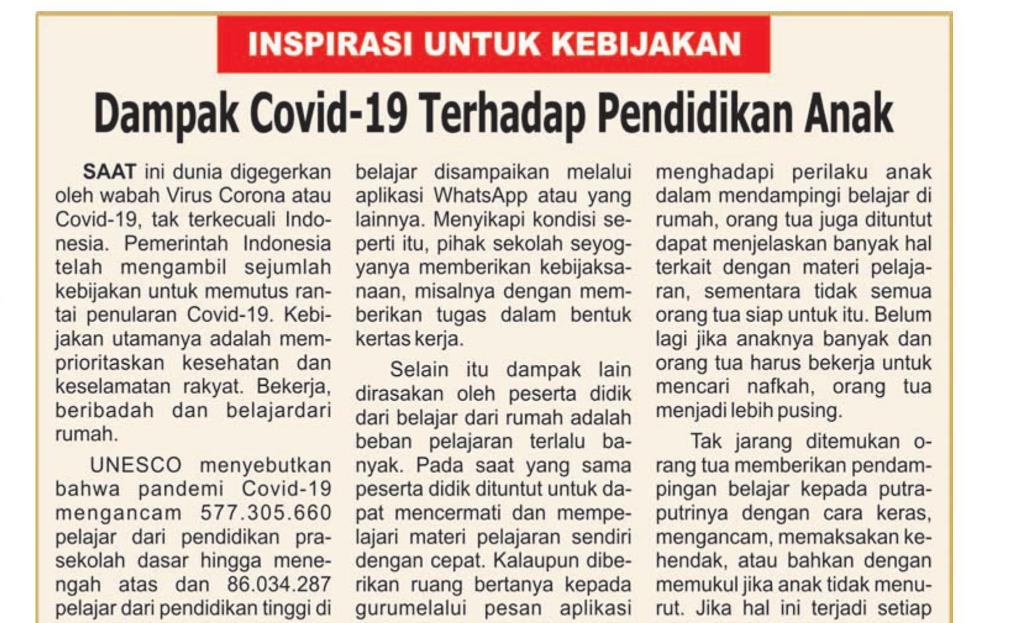
At present the world is stirred by the Corona Virus outbreak or COvid-19, Indonesia is no exception. The Indonesian government has taken a number of policies to break the chain of transmission of Covid-19. Its main policy is to prioritize people's health and safety. Work, worship and study from home.
UNESCO said that Pandemic Covid-19 threatened 577,305,660 students from pre-primary to high school education and 86,034,287 students from tertiary education worldwide. Like the policies adopted by various countries affected by Covid-19 disease, Indonesia closed all education activities. This makes the government and related institutions present alternative educational processes for students by learning from distance or study from home with the assistance of parents.
The implementation of long-distance teaching and learning policies from home or online learning does not seem to be a problem for some universities that already have online-based academic systems. It became a problem for some other universities that do not have the system.
At the level of primary, secondary and higher education technically the distance learning process also experiences many obstacles. Students from families who do not have internet access or even do not have mobile phones would likely miss learning when learning assignments are delivered through the WhatsApp application or others. Preparing for such conditions, the school should provide policy, for example by giving assignments in the form of working papers.
Another impacts felt by students from learning from home is too much learning burden. At the same time students are required to be able to examine and learn the material themselves quickly. Even if given a time to ask the teacher through the message via WhatshApp application it was still felt not enough time. And, the most easily observed by students' parents, teaching and learning from home also makes students easily bored because they cannot interact directly with the teacher and their friends.
Therefore, by learning from home, parents are required to maximize their role in accompanying their children. Especially if they are still in elementary preschool and elementary school. Because at their age, their nature is unique, energetic, active, spoiled and ego-centric (ego is high). This is where parents should be able to explore the character of their children so that the learning process from home takes place well and fun.
Learning from home allows some parents to experience stress in accompanying children if they do not understand the child's character. Parents feel that children are difficult to manage, just want to play, and lazy. In addition to dealing with children's behavior in accompanying learning at home, parents are also demanded to be able to explain many things related to the subject matter, while not all parents are ready for it. Not to mention if they have many children and parents have to work to make a living, parents become more dizzy.
It is not uncommon to find parents providing assistance to their sons and daughters by means of a hard, threatening, forced will, or even by hitting if the child does not comply. If this happens every day then it will be a scourge for children in learning, even though the parents' goals are good so that the child is disciplined and smart. Such parenting will shape children to be timid, shy, quiet, fond of breaking rules, vindictive and lacking in initiative.
Therefore parents must be careful in approaching when accompanying study at home. Parents should be able to treat children with affection, patience, accept children as they are, do not judge, do not force the will, give freedom and respect, and tolerance of their children. Thus the frightening specter of education will not be found otherwise it will create a pleasant learning atmosphere while studying at home.
________
The article was first published in Bahasa, in the rubric "INSPIRATION FOR POLICY" SKH Kedaulatan Rakyat, Friday Edition July 03, 2020.