Eliminate barriers for elderly voters
Tuesday, 16/04/2019SurveyMETERRiska Dwi Astuti*


The General Election Commission (KPU) has made efforts to maximize voter turnout rate by providing ease especially for people with disabilities, the elderly and pregnant women. Polling station committees must consider several criteria regulated by the KPU; for instance they should not be on a hill, or be of rocky or sandy terrain and should have stairs where necessary. Among other technicalities, the table height of the polling booth must also be in the range of 75-100 centimeters.
Election organizers may prioritize those with disabilities, the elderly and pregnant women in the queue of voters. Local election committees also stand ready to facilitate voting for those who are physically restricted to visit the voting location.
But how about the elderly who are not sick but too weak to go to their nearest polling station? Firstly, they are not categorized as those who must be facilitated as they are not sick; they or their family might be reluctant to ask for the facility. Therefore they are neither explicitly entitled to the right to be accompanied while casting their vote. However as many of the elderly’s physical functioning has declined, they should have the right to be accompanied in casting their vote, which should remain discreet.
Based on Indonesian Family Life Survey (IFLS) in 2007 and 2014, the percentage of the elderly who did not vote increased in all national elections for the president. Difficulties in daily activities were found to have played a significant role. The surveyed elderly were revealed to include those experienced difficulties in daily routines such as dressing, standing and going to the toilet without help and walking at least 1 km with little help. Despite other possible factors of lower elderly turnout, statistics suggest the difficulties in daily routines must be taken into account.
In Surakarta, Central Java, KPU volunteers conducted briefing for 55 elderly people at a home for the elderly in early April. One volunteer stated the elderly expressed enthusiasm but that they needed more intense briefing.
Data of the IFLS also revealed that the educated among the elderly were more likely to vote in national elections. Meanwhile one-third of them had never enrolled in formal education; under 8 percent had entered senior high school whereas only 4 percent had ever studied in college. This means briefing the elderly, similar perhaps to the bulk of the population, should be as uncomplicated as possible. Family members should be involved to be able to brief their elders.
According to Statistics Indonesia (BPS) 23.4 million or around 8.97 percent of Indonesia’s population were aged 60 and above in 2017, who have now likely increased. All stakeholders, along with family and household members should assist the elderly on Election Day.
The home visits should include those who may not necessarily be sick but maybe too weak to easily access polling stations and cast their ballot. Additionally, they may need assistance in voting though they are not disabled.
***
*The writer is a researcher in the SurveyMETER NGO, who graduated from the Magister program in economics from the Gadjah Mada University (UGM), Yogyakarta.
Source: https://www.thejakartapost.com/academia/2019/04/15/eliminate-barriers-for-elderly-voters.html
Encouraging the Birth of Elderly Policy Formulation in the Bali Province
Friday, 27/07/2018SurveyMETERWayan Suriastini, Yuda Turana, Luh Ketut Suryani, I Wayan Sukadana, Bondan Sikoki, Firman Witoelar, Cokorda Bagus Jaya Lesman, Endra Dwi Mulyanto, Roni Hermoko, I G. A. A. Apsari Anandari
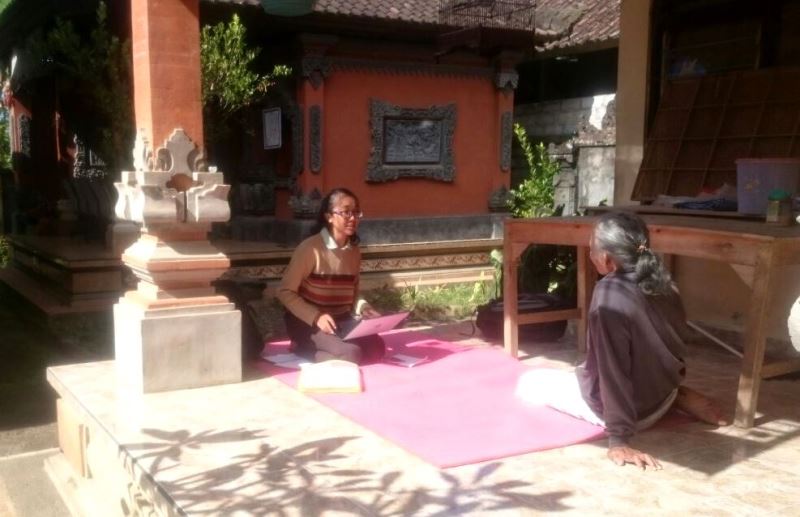
The Bali province has entered the era of the aging population structure in 2017 as the percentage of the elderly population reached 10.79%. The condition places Bali with the highest number of elderly people outside the Java area. Improvements in health, migration, high life expectancy, and the success of family planning programs have contributed to the increasing number of elderly people in Bali. The population aging phenomenon did not solely occur in Bali but also nationally and globally. Along with the aging population, degenerative diseases such as dementia are also increasing.
Dementia is a disease with a series of symptoms of decreased brain function such as memory, emotion, problem-solving, including communication that is progressive in nature to the point where it is no longer possible to carry out daily activities. In 2015, the World Alzheimer's Report estimated there were 9.9 million new cases of dementia each year worldwide and one new case every three seconds. The economic costs incurred for the upper-middle-income countries, such as Indonesia, are estimated at US$ 2.2 billion per year. This fee includes medical, social, and informal nursing costs.
Until the end of 2015, data on the prevalence of dementia at the population level was not available in Indonesia. The SurveyMETER study in Yogyakarta at the end of 2015 was the first study in Indonesia on the prevalence of dementia at the population level with a large sample. Indonesia is in dire need of dementia prevalence data in other provinces for planning for dementia management at local and national levels.
The Dementia Study in Bali Province conducted in March-April 2018 could answer the challenge of the need for data at the population level outside Java. In order to provide information as well as to find out the condition of dementia outside Java in general and Bali in particular. The study was conducted by SurveyMETER in collaboration with the Faculty of Economics and Business at Udayana University, the Suryani Institute, and Alzheimer's Indonesia (ALZI) with support from the Knowledge Sector Initiative (KSI). The study was conducted in all regencies/cities in Bali Province with a total of 1,685 elderly respondents in 117 villages. The data is then analyzed based on risk factors to support the birth of a sustainability policy in Bali which includes a policy for people with dementia.
Similar to Yogyakarta, the study in Bali used three instruments: MMSE, AD8, and IADL for the elderly who answered themselves during interviews and used AD8 and IADL from their caregivers. The data shows that the prevalence of elderly dementia in Bali Province is 1.6 times higher than the elderly in DI Yogyakarta.
This is due to the various risk factors that the elderly in Bali have greater scores than those compared to Yogyakarta. Among these factors are lower education levels for older adults in Bali, more living in rural areas, more reporting of high blood pressure, more unemployed people, and more older adults not participating in elderly activities.
Bivariate analysis showed the elderly who participated in social activities or occupied a job reveal a much lower prevalence of dementia (half) compared to unemployed elderly or unengaged in social activities. Elderly who are still working or doing social activities in Bali Province with dementia reached 23%. The prevalence of dementia is not solely influenced by employment status but also by the type of work. Jobs such as unpaid or paid family workers with clear working hours provide little stimulation to the brain so that it has the highest prevalence rate, then was self-employed, and the lowest prevalence occurred in those with the status of private or government employees.
In order to prevent dementia and ensure that the elderly are always healthy, have the opportunity to participate in the economic and social fields, it is necessary to establish a friendly area for the elderly and dementia. Elderly and dementia-friendly areas will improve the quality of life of People with Dementia and their caregivers. The four main components of a dementia-friendly area are People with Dementia themself, community, institutions, and partnerships.
The Alzheimer's Disease International (ADI) document in its presentation on the principles of the physical environment specifically mentions the need to identify opportunities to collaborate with groups that carry out elderly-friendly area initiatives. In Indonesia, regulations for the establishment of an elderly area have developed quite rapidly after a study conducted on the capacity assessment of elderly-friendly cities in 14 cities in 2013 by the SurveyMETER and CAS UI studies. In 2017, Regulation of the Minister of Social Affairs of the Republic of Indonesia Number 4 concerning Guidelines for the Development of Elderly Friendly Areas was issued. The guidelines not only cover the eight dimensions of WHO 2007 elderly-friendly cities but also contain a number of important dimensions that are added to adapt to the context of problems in Indonesia, including having a sustainability policy, religious and mental-spiritual services, social advocacy, legal assistance; and/or protection of the elderly from threats and acts of violence.
The first criteria to categorize as an elderly-friendly area is to have a policy for the elderly. The policy must reflect partiality to the elderly and indiscriminative. It can be in the form of a regional regulation or a regional head regulation. Those are translated into the strategic plans and financing are sourced from the regional budget (APBD), state budget (APBN), grants, etc.
The existence of an elderly policy that includes people with dementia policy is very important because: it can ensure the establishment of an elderly-and-dementia-friendly area; make health policies and social services related to the elderly and dementia a priority; improve the knowledge, understanding, attitudes, and behavior of public servants and professionals related to elderly and dementia; increase investment in health and social systems to improve care and services for the elderly and dementia; increase the priority of the research agenda on the elderly and dementia. All of the efforts will lead to strengthening the position of the elderly in the country to strengthen development, preserve cultural values, and inspire the young generation.
The moments of Grannies Do Gymnastics Anti-Senile and Be Creative with Banana Leaves and Big Palm Tree Leaves (Janur)
Tuesday, 02/01/2018Guwosari, Pajangan, BantulJejen Fauzan

We arrived at the hamlet head house less than ten minutes from nine in the morning when the program started. It seems that tens of elderly and posyandu cadres have been waiting for our arrival. Some of them even came before seven am. They waited for us (and the village head) for more than 30 minutes in the living room and in the lobby, after the weight checks, blood pressure checks, and eating supplementary food (PMT).
Our enthusiasm was fueled by theirs. They just obeyed when we asked to move by sitting on a mat in the courtyard of the house. They were also loyal to remain still at the place when the morning drizzle had fallen for a moment. We expect the enthusiasm will be a good start for future program implementation.
Sunday morning December 31, was a special event for them and of course also for us. We called the activity on the last morning of 2017 the “Iroyudan Hamlet Elderly Gathering Activity” to mark and welcome the assistance program for the Bougainvillea Elderly Posyandu activities in Guwosari Village which was conducted by SurveyMETER as of January 2018. It is a small program of SurveyMETER in an effort to create an elderly-friendly community. The Iroyudan became the second hamlet that was accompanied after Watugedung.
“Starting January next year, the service for the elderly posyandu will be separated from the toddler one. Every implementation will carry out health checks and elderly gymnastics with varied materials and agendas. We also schedule a home care program for the elderly who are bedridden (got sick and being only lie down at home)”, said Titis Putri Ambarwati, program coordinator, in front of the audience.
“I expect all of the elderly to enthusiastically participate in posyandu activities since by being active in Posyandu may find out about health. Health is very important and we must take care of it constantly. In addition, posyandu is also a melting pot for friendship and chatting with others,” said the Village Head of Guwosari Village, H Suharto, in his remarks. He also thanked SurveyMETER for expanding the range of assistance.
Furthermore, a series of activities ran smoothly, naturally, and enjoyably. All audiences were enthusiastic when invited to play anti-senile gymnastics. Their smiles and laughter broke out between movements. Some of them who are unable to do so participate while sitting.
They also nodded in understanding when a SurveyMETER researcher, Endra Dwi Mulyanto, explained the results of a study on (and the importance of) posyandu for the elderly conducted in Bantul regency. He conveyed the results of the study in easy-to-understand language, including when recommending an increase in the allocation of village funds to support posyandu activities for the elderly. He added that based on the study results, the joint task is to encourage the activity of male elderly are far below the female one. “Health is the capital of life." In addition, being active posyandu for the elderly is part of the spirit of the Healthy Living Community Movement (GERMAS) promoted by the Indonesian Ministry of Health," he said. Having completed the presentation and representing the management of SurveyMETER, he symbolically delivered a set of Portable DVD Players to assist the posyandu cadres in learning various exercises for the elderly.
After a while, they were invited to remember their youth and childhood. The male elderly are welcome to create something originating from palm tree leaves while the female ones from banana leaves. A few minutes later the Master of Ceremony called the first finisher to show his creation. He came forward to approach the MC with a woven keris in hand. An eccentric creation from him was greeted with boisterous laughter from others. The atmosphere was shining and lively. By his agility, he was awarded a door prize.
Then some grannies scrambled to get to the MC, showing off their creations in order to get gifts. Two grannies snatched to compete for their creations showing off their work, followed by the others. We and the cadres certainly provide excess gifts so that all the participants get a share. In addition to woven keris, several other creative products are produced ranging from various types of diamonds, whips, birds, propellers, trays, plates, pads, wrap, and similar foods packaging.
To avoid scrambling over the gifts, the MC changed the terms for getting a gift by allowing them to show their "hidden talent". A grandfather who claims aged 95 years old started by singing the national anthem, Indonesia Raya. The alternating and back-and-forth pronunciation of the verses and the hoarse voice (maybe because of his missing teeth) made the atmosphere full of laughter and admiration. Then a granny asked to sing Indonesia Raya again. She became the conductor with enough appreciation that she was able to echo Indonesia Raya for the second time quite well and completely. Ultimately, a grandfather consolidated the festivities of the event by singing literary art songs full of advice.
On the morning of the last day of 2017, we really had a great time, that was fun, we were certainly proud, happy, entertained, and grew excited looking forward to 2018.
The moment of Elementary School Students Learn to Write About Elderly
Tuesday, 03/01/2017Guwosari, Pajangan, BantulJejen Fauzan
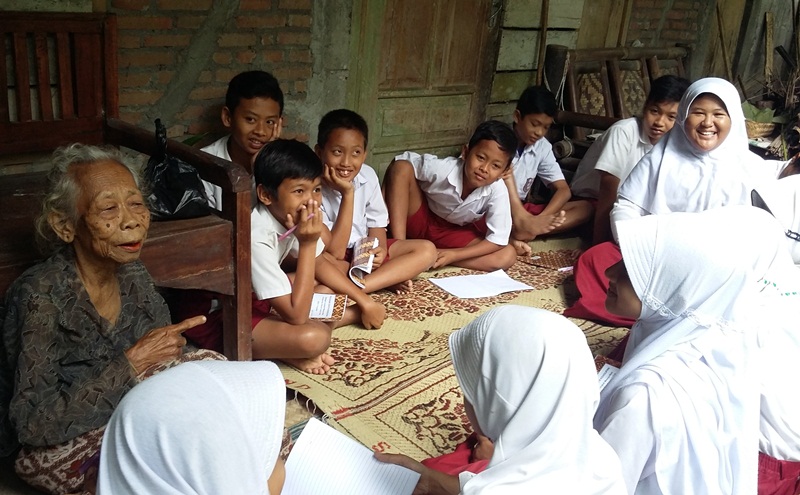
The learning group of fifth-grade students at Iroyudan public elementary school, Guwosari, Pajangan, Bantul, appeared happy and curious. That Tuesday morning, December 13, 2016, the Indonesian language teacher and us invited them to study with an elderly named Mbah Girah in Watugedug hamlet, Guwosari. They were curious since it was the first time to learn directly from an elderly person.
Prior to leaving, we just brief them that we will meet and learn with an elderly and please ask her anything. It could be about the name, age, relatives, occupation, and so on as well as observing conditions around the house. If she didn't understand Indonesian, they could ask her in higher-grade Javanese language (Krama Inggil), then wrote down all her stories and their experience after interacting with her as an individual task.
On a mat of stucco floor, on the veranda of Mbah Girah's house, they were scrambled for a place, expecting to be closer to her until finally they could encircle and surround her. Mbah Girah sat in their midst, ready to answer and tell stories in front of them.
They began to ask her alternately: "Mbah, how are you? what is your name?", "How old are you?", "What do you do?", "Whom do you stay with?", "How many children do you have?", "How many siblings do you have?", "How many grandchildren do you have?", etc. But Mbah Girah did not understand the meaning of "work", "have", and some of the questions' vocabularies, and they were confused to find the higher-grade Javanese language of these words.
Finally, they asked the teacher as well as us, feeling that the question has not been answered, some of them repeat the question; "What do you do every day, Mbah?", "How many children do you have?", "Do you have any relatives?", and "Did you ever enroll in school?".
She answered their questions with a long story and quite a loud voice. Only the following questions from them could stop or pause the story. The moments when it came to being pulled like that, she gasped. She forgot the plot for a while and then laughed, revealing the remnants of her brown teeth, made the children laugh at the natural funny granny.
Answering questions about her age, Mbah Girah said that when Indonesia became independent in 1945, she was already a girl, aged 16. "Please add it, until now," she said with a chuckle.
Without waiting for the next question, she also talked about the history of her life during the Japanese colonial period. She said it was very apprehensive at that time, you might go to school but you didn't have books, the clothes you wore were made of gunny sacks that are itchy with lice, eating bran, living in a bamboo house that illuminated by oil lamp at night, and so on. She also told us that her school during the Japanese colonial period was not graduating students since the conditions did not allow it.
A moment later, Mbah Girah talked about “gendis” as a snack in her childhood and the origins of a “sendang” which became the source of life in her village. A child asked, "what are gendis and sendang?". The teacher answered that gendis is candy while sendang is water springs.
So, that morning in the valley, on the veranda of that homely house, behind the valley of the Selarong cave area, smiles and laughter of joy sprout from the fifth-grade elementary school students, also from Mbah Girah. It is a learning simulation from the “Story of Life Program”. After this, they will conduct individual visits and “interviews” with the elderly except their grandparents who are in their environment 3 times in a span of 10 weeks, they were assigned to write down the results.
“The pilot activity was carried out in 3 elementary schools, 2 junior high, and 2 senior high/equivalent in Pajangan District. In addition to providing rewards, we would also work with print media to publish their best writings. At the end of the program, in March or April 2017, we planned to invite all participating schools and stakeholders to present the results of the activities. If it would be successful, we planned to develop similar activities in a wider area,” explained Titis Putri Ambarwati, program coordinator.
According to Titis, it aims to foster respect for the young generation for the elderly and their future learning. It was part of an effort to realize an elderly-friendly community initiated by SurveyMETER Yogyakarta referring to the assessment study results of the elderly-friendly cities of 14 cities in Indonesia conducted in 2013.
TOWARDS AN ELDERLY FRIENDLY COMMUNITY
SurveyMETER is an Independent Research Institute based in Yogyakarta. Our Vision and Mission is to be a knowledge institution to inspire and strengthen the evidence-based policy. Our research focus is on health, education, and disaster issues. One sub-sector of health that we continue to work on is the issue of aging (population aging).
Two-Year Reflection Seminar on the Maneges (Rediscovering) Village Law
Monday, 21/12/2015Desa Wukirsari, Imogiri, BantulEdy Purwanto, S.P, M.Sc.
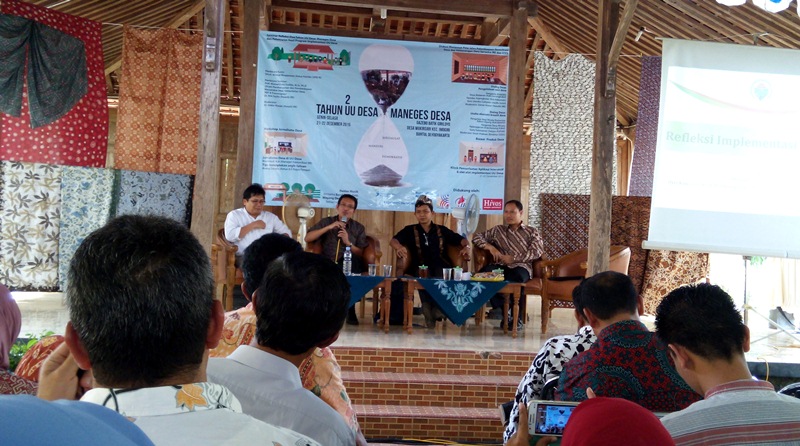
In commemoration of the 2nd anniversary of Law Number 6 of 2014 concerning Villages, the Institute for Research and Empowermentire (IRE) held a Two-Year Reflection Seminar on the Village Law. The seminar was held at the Giriloyo Batik Gazebo, Wukirsari Village, Imogiri, Bantul, on Monday, December 21, 2015. SurveyMETER presented as a participant on this occasion. SurveyMETER and IRE are members of the Knowledge Sector Initiative (KSI).
The seminar theme was village management. Maneges Desa means reinforcing the village. It can also mean reinterpreting by doing self-reflection. From this seminar, participants are expected to reflect on the progress of implementing the Village Law, namely to strengthen the existence of the village as regulated in the law.
Acting as the keynote speaker was Drs. H. Akhmad Muqowam (Chairman of Committee I DPD-RI). The speakers were Prof. Achmad Erani Yustika, M.Sc, Ph.D. (Directorate General of Village Community Development and Empowerment of the Ministry of Villages, PDT, and Transmigration), Dr. Tugiman from the Ministry of Human Empowerment and Culture, and Dr. Arie Sujito (IRE Researcher). Meanwhile, the moderator was Dr. Abdur Rozaki (IRE Researcher). Participants consisted of village heads, village representative assembly (BPD), village MSMEs, local governments, district representative assembly (DPRD), NGOs, and academics.
The ceremonial event commenced with remarks from Wukirsari village representatives later followed by Sunaji Zamroni as the chairman of the committee. Continued later with the launching of village assistance Instruments, then launching off the trial results of institutionalizing villages democratization and authority. In this session, the IRE and the CCES research teams introduced several materials including modules, applications of Desakita, village council videos, photos, and infographics. Three applications that have been successfully developed by the Center for Civic Engagement and Studies (CCES) can be downloaded on the google app and used offline including our village site in www.desakita.id, village learning in www.learning.desakita.id and building villages in www.bangun.desakita.id
Stepping on the presentation session, Drs. H. Akhmad Muqowam as the legislator when the Village Law was drafted, invited all participants to reflect back on institutions at the central level. The law mandates that the ministry responsible for implementing the Village Law is one ministry. But now, in reality, the authority at the central level is divided into the Ministry of Home Affairs, the Ministry of Villages, PDT and Transmigration, the Ministry of Finance, and the Ministry of Human Empowerment and Culture. This causes difficulties in coordinating the implementation of the Village Law. This is thought to be one of the reasons for the lack of success in implementing the Village Law in this first year.
Furthermore, the three seminar speakers invited participants to reflect on some of the existing shortcomings and then jointly look for the right improvement solution. Albeit the Village Law implementation in the first year still had many deficiencies such as lack of coordination, delays in disbursing funds, lack of assistance, and lack of administrative reporting, but all felt confident the utilization of it would be better in the following year. It was expected all village officials would not only focus on the existing funds since they would certainly continue to exist and would always increase as long as it had not been revised. In the future, the village government should focus more on the other mandates of the village law, especially in terms of fighting for village authorities such as the authority of origin and the authority to manage existing natural resources.
SurveyMETER intrinsically can take on a role to contribute to overseeing the implementation of the Village Law. The steps included analyzing and using big data by downloading from all available platforms.
Learn to Persuasion the Elderly from Karanglansia Rahayu
Thursday, 19/11/2015SurveyMETERJejen Fauzan*
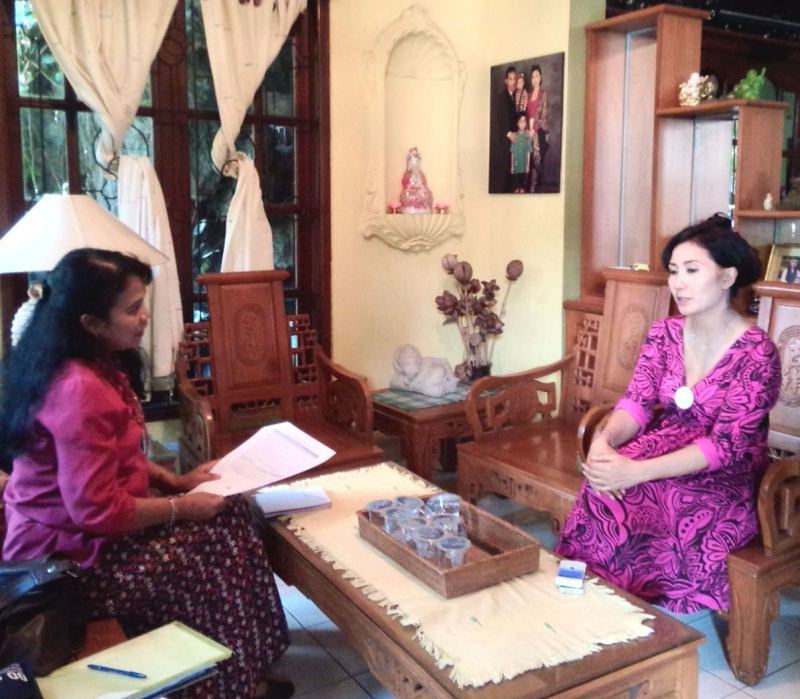
“The greatest happiness beyond measure is at the moment when I see them happy. When a blind elderly heard my voice, she spontaneously called me "Mother". If only she met me merely as a staff, perhaps she just calls me a miss."
Those are some closing words of the sharing conversation with Frida Citra Dewi, founder of Karanglansia Rahayu, Danginpuri Kangin Village, Denpasar. The sentence reaffirmed her introduction at the beginning regarding the things that prompted her to initiate the establishment of an elderly community that covers one village. We visited her on purpose to find out more than just to confirm how a dissemination result of the elderly-friendly city capacity assessment study (conducted in 2013 with a sample of Denpasar City) was presented last year, inspiring the city's elderly policy. "My goal is none but looking for saving my hereafter, just inviting them to play for having fun," said Mother Frida, starting the conversation.
According to her, Karanglansia Rahayu is the only elderly community at the village level out of 42 wards in Denpasar city. The elderly activities in other villages are still scattered in every Banjar (hamlet). Even then its existence is between presence and absence depending on the activity of the elderly posyandu.
Mother Frida's age has not reached the pre-elderly category though, but that is not an excuse for her not to care about the elderly. In the past, she was also the administrator of the toddler posyandu in her Banjar. Now, she sees, parents of toddlers in urban areas are more concerned and understand about the health of their children. They have a lot of information literacy about toddler health. Meanwhile, who will care for the elderly?
She talked about the genesis of the Karanglansia Rahayu establishment on 27 February 2014. She assumed the current Denpasar city government paid enough attention to the issue of the elderly. Proven that the deputy mayor himself was the chairman of the Denpasar City Elderly Commission that had a plenary elderly posyandu program in every village. It was a kind of the peak of the furor for the elderly posyandu activities by implementing many services available for the needs of the elderly such as free health checks, providing additional food, competitions, or distribution of uniforms for the elderly. This program is held once a year in each village. It is usually held once a year in each village where the maintenance rotated in each banjar. The Danginpuri Kangin has 8 banjars.
She thinks to activate the elderly program: Shall we wait for the next plenary posyandu to hold on again? Shall we have to wait for 8 years to take care of the elderly? Why don't we make it on our own?
For Frida, the elderly need the attention of people who are not elderly. They need to be happy and something that can drive away loneliness in retirement probably causes them to become bad-tempered due to work syndrome. So, they need friends and community. However, excessive persuasion is needed to invite them to be active since most of them feel ashamed, unnecessary, and so on, until the problem is no support from their families.
Then, with the help of friends and all of the Klian (Head of Hamlet), she recorded all the elderly living in her village. Later formed a board from the elderly representatives of the entire banjar. “We made a proposal; we did fundraise to friends in the DPRD. Then the first thing I did was make uniforms for them, with that uniform, they feel recognized. Later, we invited them to join the elderly gymnastics, osteoporosis exercise,” said Frida.
The next activity was only added with psychological material and ice-breaking so that those with tremors were motivated to move. The regular exercise was carried out on Friday while the Osteoporosis was on Sunday. The big event like the elderly celebration was routinely held every 3 months.
“Initially only a few elderly interested in joining the Karanglansia Rahayu. Time by time, many of those who just joined stated they knew it by word of mouth. Why wasn't I invited? So that the number of members increasing to reach 120 people. She explained it was still a small amount, quite far from the target since the elderly living in a banjar could reach 50 people. In the village, with a population of around 3000 people, the number of elderly reached 300 (10%). The reasons noticed for the inactivity of other elderly varies widely, from no one to deliver in transportation to feeling inferior on involvement for not wearing a uniform.
She calls herself just an organizer, not the owner of the community. She is happy to position herself as a public relations officer for the elderly community. During the launching and inauguration of the Karanglansia Rahayu management, she invited the Mayor. In fact, it was the Mayor who gave the name Karanglansia Rahayu which means safe or healthy elderly shelter.
To minimize expenses, she invited her community colleagues to share knowledge and proficiency with the elderly. Coincidentally, she is also the caretaker of an osteoporosis prevention organization in Denpasar. So for convenience and free of charge terms, gymnastics is the choice. In a talk show about the health of the elderly, especially the prevention and treatment of diabetes and rheumatism, she invited doctors who practice in her area to share. Luckily again, some of the elderly in their community are already information literate, and they continue to campaign the programs to their friends by word of mouth.
The talk show theme also developed. She and her colleagues in the community disassociated the participatory method that applied. They were invited to participate to arrange activities or to provide meeting materials. Among them were suggestions for consultation on household problems and their relations with children, daughters-in-law, and grandchildren. In a routine of 3-month activities, it was also associated with some events such as celebrating the National and the World Elderly Day, taking the moments as a reminder to them that days of celebration exist.
After several months of intense activity, Karangansia Rahanyu was registered and became a reference for the Denpasar City social service, the elderly commission, and other government institutions. They were always invited both from the service office or the elderly commission on activities regarding the elderly topics. Likewise, if there is an elderly talk show from the hospital and the Faculty of Medicine, Udayana University, the community must be invited to get involved. In a number of activities, Karanglansia Rahayu collaborated with the Manuaba and the Puri Raharja hospitals even though they were outside the village area.
Despite being young age, the Karanglansia Rahayu community had a memorable experience. They were involved in elderly research conducted by lecturers and students of Japan Sinjoku University a few months ago. They became research objects for 6 months got treatment putting on removable tools except when bathing to measure fitness. They were even happy to find out blood sugar levels, the pulse and tension of the heart, and so on for free. The Japanese researcher's impression was surprised themselves by the enthusiasm of the Karanglansia Rahayu members.
SurveyMETER Siap Berkontribusi dalam SDGs Indonesia
Wednesday, 07/10/2015SurveyMETERJejen Fauzan

Banyak pihak menyakini Sustainable Development Goals (SDGs) merupakan kelanjutan dari Millenium Development Goals (MDGs) yang mencapai tahap akhir di tahun 2015. Karena dari 8 target MDGs yang belum tercapai kembali menjadi target SDGs dengan lebih ambisius dalam 17 target. Pihak lainnya melihat SDGs bukan kelanjutan dari MDGs karena secara substansi target SDGs lebih pundamental, holistik, dan partisipatoris.
Namun demikian, penandatanganan SDGs 2015-2030 pada September 2015 segera akan ditindaklanjuti oleh 177 negara yang turut menandatangani. Di berbagai negara SDGs ini menjadi kerangka pembangunan ataupun menjadi acuan perundingan pembangunan pasca 2015 termasuk di Indonesia. Wakil Presiden Jusuf Kalla pada pidatonya dalam Sidang Umum Persatuan Bangsa-bangsa (PBB), Sabtu (26/9/2015), mengatakan agenda pembangunan setelah tahun 2015 adalah janji untuk generasi masa depan. Pemerintah bakal berupaya untuk meninggalkan sebuah warisan dunia yang lebih sejahtera lewat pembangunan.
Sementara untuk mewujudkan program pembangunan berkelanjutan yang berkualitas dan tepat sasaran setiap program dan kebijakan harus berdasarkan data yang baik. Sebagai lembaga penelitian yang bervisi sebagai Lembaga Pengetahuan yang Menginspirasi dan Memperkuat Kebijakan Berbasis Data Penelitian, SurveyMETER siap membantu pemerintah Indonesia untuk menghadirkan data berkualitas bahkan berbentuk data panel. Tentu ini menjadi kesempatan yang menantang.
Dengan 17 target capaian, kebutuahan SDGs terhadap data akan lebih besar dibanding MDGs. Tentunya selain menggunakan sumber data yang selama ini menjadi acuan kebijakan pembangunan, pemerintah juga diharap membuka diri terhadap data penelitian yang dilakukan oleh lembaga penelitian independen. Data tersebut dapat dijadikan acuan ataupun sebagai data pembending dari data lainnya.
Untuk mengenali dan mempersiapkan diri mengahadapi tantangan tersebut Tim Kajian SurveyMETER mendiskusikan SDGs ini pada Selasa (6/10/2015) lalu di Ruang Meeting Lt. 2. Dari pengenalan dan diskusi tersebut SurveyMETER harus siap berkontribusi dalam SDGs Indonesia. Semua staf peneliti harus lebih bekerja keras mempersiapkan diri.
Pada era MDGs, SurveyMETER sudah berkontribusi melakukan penelitian independen untuk mengevaluasi kebijakan yang berkaitan dengan 8 target MDGs. Berkaitan dengan sanitasi SurveyMETER telah melakukan survei evaluasi program WSLIC 2 tahun 2010. Berkaitan dengan kemiskianan melakukan penelitian Survei Sosial Ekonomi Rumah Tangga Indonesia (SUSETI) tahun 2008-2013, survei evaluasi Program Keluarga Harapan (PKH), dan evaluasi Program Raskin. Terkait program mortalitas, melakukan penelitian evaluasi program stunting (MCA dan SKAI) tahun 2014.
Aceh, example of slow but permanent recovery after 2004
Tuesday, 23/12/2014SurveyMETERElizabeth Frankenberg, Duncan Thomas, Bondan Sikoki, and Cecep Sumantri
On a sunny morning on the west coast of Aceh, mothers chat near a calm blue sea as children play nearby. It is almost unbelievable that 10 years ago, on Dec. 26, 2004, waves 18 meters high surged through this village and many others, leaving about 170,000 people dead.
Indonesia’s government, donors, NGOs and individuals contributed roughly US$7 billion in aid for Aceh and the government established a high-level bureau based in Aceh to coordinate recovery. What did these resources buy?
Initially progress was slow; frustration was high. But 10 years on, a very different picture has emerged. Life has returned to something that feels normal. It’s a recovery in which Aceh, Indonesia and the world should take pride — but it did not come quickly, easily or cheaply.
We led an international team of scientists for the Study of the Tsunami Aftermath and Recovery (STAR). Beginning five months after the disaster, we searched for 32,320 people first interviewed as part of a 2004 survey in nearly 500 communities along the coast. Of the 30,000 survivors, we interviewed 96 percent in follow-up surveys between 2005 and 2010 to measure the immediate impact of the tsunami and subsequent recovery in badly damaged communities in comparison to communities not directly affected.
The tsunami tore apart networks of family, friends and neighbors. In some communities, 80 percent of the population perished. Within four months, nearly two-thirds of those in severely damaged communities had moved away.
It took time to establish property rights and assemble construction materials, but within five years these individuals lived in family-owned homes at the same rates as before the tsunami. They formed new families through marriage. In communities where tsunami mortality was higher, we saw a greater fertility increase in the five years after the tsunami. Recently married couples had their first babies and mothers whose children had been killed gave birth again.
Some women were pregnant when the tsunami struck, and their needs were particularly acute. Two years after the tsunami, children in utero at the time of the tsunami were shorter for their age than Acehnese children born before the tsunami, probably reflecting their mother’s stress and reduced resources.
But within three years, in terms of height-for-age, most of these children had caught up to or even surpassed their older counterparts. Post-tsunami assistance provided a health advantage that may turn out to be permanent.
Not everyone recovered to the same degree. The loss of one or both parents took a toll on children aged 15 to 17 years. Five years after the tsunami, these boys left school and entered the work force at higher rates than boys whose parents survived. Older girls who lost both parents married sooner. Among younger children, schooling outcomes did not differ although gaps may emerge. A man whose wife died was much more likely to remarry than a woman whose husband died.
Major shifts in the labor force accompanied reconstruction. Among adults from heavily damaged communities, the proportion of young males and young and middle-aged females working increased, but employment rates declined markedly for middle-age males and modestly for older males and females (relative to rates for individuals of the same age but from other areas).
Over the last decade, hurricanes, earthquakes and tsunamis have struck the US, Pakistan, China, Myanmar, the Philippines and Japan.
Aceh’s example is striking. The hard work and perseverance of families and communities — combined with the commitment of the provincial and national governments and the generosity of the international community — have helped Aceh recover to a degree simply unimaginable in the months after the disaster. When the next natural disaster strikes, Aceh provides a compelling reminder that recovery efforts really can make a lasting difference.
_______________
Elizabeth Frankenberg and Duncan Thomas, of Duke University, and Bondan Sikoki and Cecep Sumantri, of SurveyMETER Indonesia, led a team studying the 2004 tsunami in Indonesia.
Source: http://www.thejakartapost.com/news/2014/12/24/aceh-example-slow-permanent-recovery-after-2004.html