Health Promotion Seminar: Health Promotion Workforce Contract Opportunities Using the BOK Fund Budget
Monday, 06/02/2017Yogyakarta


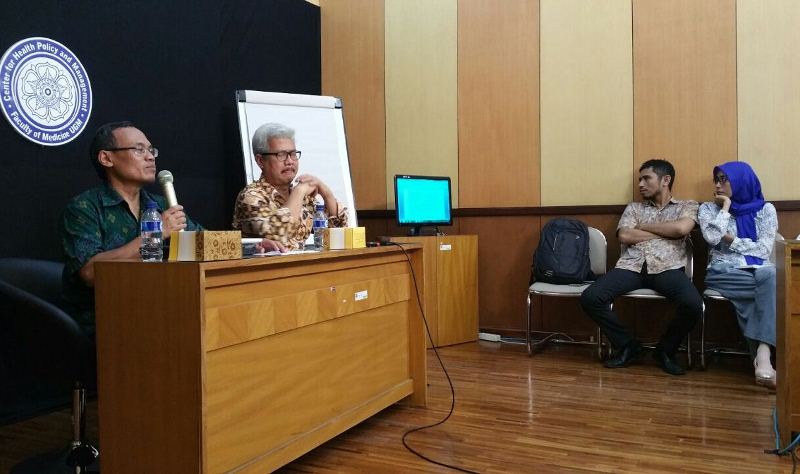
Until now puskesmas in Indonesia have been faced with the problem of promoting health to the community. Whereas puskesmas can take advantage of health promotion contract opportunities using the Health Operational Assistance (BOK) budget. The problem is that most puskesmas are not ready for this opportunity, so currently contracts are limited to individual contracts.
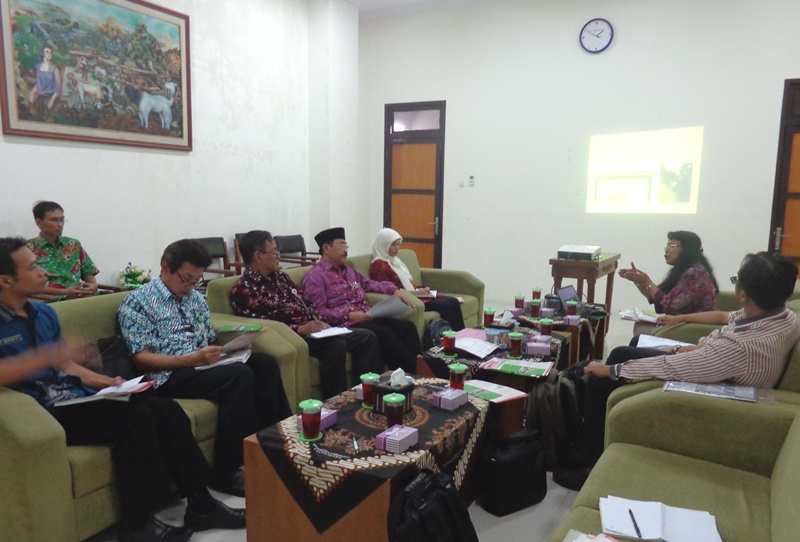
This condition was revealed in the 1st Seminar on health promotion (Promkes) "Development of Entrepreneurship in Contracting Systems for Public Health for Prospective Provider Institutions in Relation to the Use of BOK Funds" held by the Health Policy and Management Center (PKMK) UGM Faculty of Medicine on Friday (3 / 02/2017) in the Leadership Room of IKM FK UGM Building.
This seminar is planned to be held 3 times in the next 3 weeks and will close with a workshop. The 2nd seminar will be held on February 10th and the 3rd seminar on February 17th at the same place. While the closing workshop will be held on February 23.
Appearing as presenters and reviewers in the 1st seminar were Prof. Dr. Laksono Triasnantoro MSc, PhD, Dr. Dwi Handono Sulistyo MKes, and UGM PKMK Team. Besides as a participant, Endra Dwi Mulyanto was a representative of SurveyMETER, the seminar was also attended by representatives of the Yogyakarta Health Service, UGM Alumni Graduate School, and a number of UGM Faculty of Medicine students.
Therefore this seminar was held with the aim of discussing the existence of a contract revolution in which contracts are not only for individuals but also for institutions. Indeed, individual contracts have weaknesses in terms of supervision while the agency contract system will be able to provide better benefits where indicators of work achievement are more easily known. However, when using an agency contract system, it will be faced with the legal problem, the conditions that must be completed by the institution, the mechanism that must be prepared properly, knowing how much scope will use the system, and the problem the provider is ready or not, and so on. Specifically from the series of seminars to the workshop, all participants will discuss issues and steps to create an instrument or mechanism for an agency contract system.
As released on the website of the Ministry of Health of the Republic of Indonesia (http://www.depkes.go.id/article/view/X-3006/faq-for-apa-saja-pengfaat-dana-fantuan-operasional-k Kesehatan-bok.html) BOK funds can be utilized for: first, Local Transport. Second, Official Travel in the District / City (in the Regulation of the Minister of Finance of the Republic of Indonesia No. 37 / PMK.02 / 2012 concerning 2013 Budget Year Cost Standards). Third, Purchase / Purchase of Goods (a) Fund the purchase / purchase of goods to support the implementation of promotion and preventive health effort activities outside the building. b) Funding the purchase / expenditure of goods to support the implementation of puskesmas management, BOK, SMD, MMD financial management. (EDM)
Seminar of JKN Ideology and Policy: The Poor People Subsidize the Rich Ones
Thursday, 02/02/2017YogyakartaEndra Dwi Mulyanto, SE
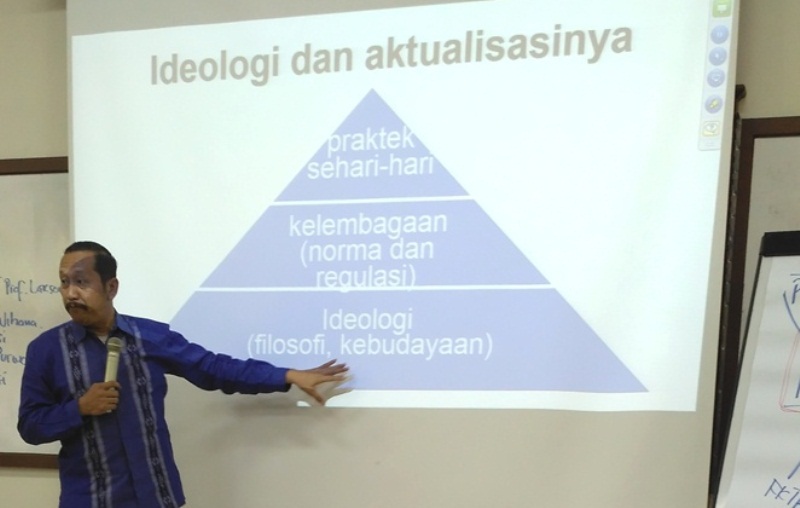
The National Health Insurance System (JKN) or the Social Security Administering Body (BPJS) is intended to provide the widest possible benefits for the poor and underprivileged communities in accordance with human dignity. However, until now the claims from BPJS participants in the Recipients of Contribution Assistance (PBI) category or participants whose contributions are paid by the Government as participants in the Health Insurance program are 85%. Likewise, claims from non-PBI participants (PNS, Jamsostek, etc.) are 90%. Meanwhile, claims from participants and Non-PBI-Mandiri: 280% so that BPJS has a deficit of around 7 trillion. So, it can be said that the current condition is not the rich people subsidizing the poor, but the contrary.
It was the important point that came up on the first part of the Seminar of JKN Ideology and Policy with the theme of Understanding the Policy Process and Evaluation. It was organized by the Center for Health Policy and Management (PKMK), Faculty of Medicine of Gadjah Mada University Yogyakarta on Wednesday, February 1, 2017, in the Doctoral Lecture Room of FK UGM.
Acting as the presenter of the seminar was Prof. dr. Laksono Triasnantoro M.Sc, Ph.D. as a senior researcher at PKMK-FK UGM. Appearing as the discussants are Prof. Purwo Santoso M.A., Ph.D. (professor at the Faculty of Social and Political, UGM), and Prof. Wihana Kirana Jaya M.Soc.Sc, Ph.D. (professor at the Faculty of Economics, UGM). It was also attended by members of the community of practice for health financing and JKN, graduate students from the department of health policy and management (HPM), graduate students in public health sciences (IKM), practitioners, academics, and researchers including SurveyMETER that represented by Endra Dwi Mulyanto S.E., M.P.H.
It was the first part of a series of 9 seminars in the 2017 monitoring and evaluation (monev) of the JKN activity started in February until the peak of the Outlook 2018 in December 2017. Other activities were a series of workshops and discussions. The purposes aim to see what ideologies are de jure and de facto in the SJSN and the BPJS Laws and to discuss the ideology in health insurance. The urgency was that after the JKN program has been running for 3 years, then policy evaluation and monitoring are needed in the 4th year.
In the JKN policy, the ideological values stated in the 1945 Constitution article 34 paragraphs 1 and 2 (that the poor and neglected children are maintained by the state and the state develops social security for all people and empowers the weak and incapable in accordance with human dignity) that later emerged in the Law No. 40 of 2004 concerning the National Social Network System (SJSN) and the Law no. 24 of 2011 concerning the Health Insurance Organizing Agency (BPJS) whether they have become a consistent basis for the implementation or not.
According to Prof. Laksono, without an ideological basis, the health coverage system that is based on health insurance may change from its basic spirit. in fact, the Indonesia JKN system results indicated that poor people still subsidize the rich ones for the last 3 years of its implementation.
Call for Joint Steps Towards an Elderly-Friendly Community
SurveyMETER continues to strive to promote the importance of creating elderly-friendly communities and cities. The following efforts are being contrived to encourage the government to recommend the 21 main indicators of WHO to develop an elderly-friendly community. All of them are the results based on the 2013 Elderly-Friendly City Assessment.
IFLS Data is of High Value in the Eyes of Policymakers
Wednesday, 03/08/2016Hotel Sari Pan Pacific Jakarta
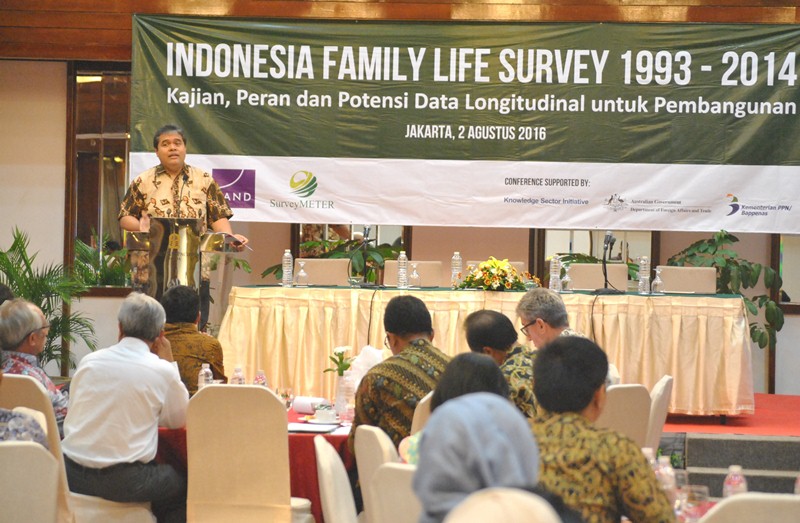
The launching of IFLS5 with a One Day Seminar "Indonesia Family Life Survey 1993–2014: The study, role, and potential of longitudinal data for development on Tuesday, August 02, 2016, at the Sari Pan Pacific Hotel Jakarta was the third stage of the IFLS5 data dissemination series. It addressed policymakers in Indonesia.
The first phase of dissemination was conducted in front of the international researchers and academics at the 2016 Population Association of America (PAA) Annual Meeting on March 31 to April 2, 2016, in Washington DC. The soft-launching IFLS5 data by RAND Corporation and SurveyMETER was also conducted. The second one was delivered to national researchers and academics at the 13th Indonesian Regional Science Association (IRSA) conference on July 25-26, 2016, in Malang city.
The Jakarta launching was successful to involve policymakers from the Coordinating Ministry for Human Development and Culture, Ministry of Education and Culture, Ministry of Social Affairs, Ministry of Health, Bappenas, Presidential Staff Office, Bank Indonesia, Fiscal Policy Agency, Central Statistics Agency, TNP2K, BKKBN, BPJS Health, and Litbangkes. Participating in this seminar were stakeholders from research institutions and NGOs such as SMERU, PPIM UIN Jakarta, IRE Yogyakarta, ELSAM, PPH Atmajaya Jakarta, the Emong Lansia Foundation, and MAMPU. In addition, international donors and research partners such as WHO, The World Bank, DFAT, UNICEF, ADB, J-PAL, Abt Associates, Rutgers WPF, and KSI also participated.
The series of events commenced with an introduction from the IFLS Principal Investigator who is also a Professor of Economics and Gerontology at the University of Southern California, John Strauss, and the SurveyMETER Executive Director, Dr. Ni Wayan Suriastini, M.Phil. She expressed her gratitude to all parties involved in the IFLS5 and declared the IFLS5 success is the fruit of the hard work of all teams, from the principal investigator to the fieldwork enumerators.
Policyholders who also participated in the seminar appreciated positively for this work. The BAPPENAS Director of Trade, Investment, and International Economic Cooperation, Mesdin Kornelis Simarmata, in his opening remarks, stated evidence-based policy is a solution to emphasize in facing 3 simultaneous challenges of public policy: globalization, democratization, and decentralization. It aims to avoid being in a political policy-making pitfall. He also expected that future research in Indonesia would be carried out by independent entities, which means that government agencies would delegate and allocate their research and development budgets to quality research firms, so they would dodge to conduct, finance, and administer research with an acquisitive arrangement (hermaphrodite) so far. With this setting, the non-government research institutions will afford to live with their works.
Meanwhile, the Head of TNP2K Policy Working Group, Elan Satriawan Ph.D., the task is to provide evidence for the decision-making process for the vice president and relevant ministers. Various data types were used both in the form of the randomized controlled trial (RCT) and non-RCT experiments, and one of the non-RCT data that has a high value and is widely used apart from BPS data is IFLS data.
Nicola Nixon, a representative from the Australian Ministry of Foreign Affairs and Trade (DFAT), IFLS data may contribute to strengthening policies and supporting other data sources. IFLS data may be combined with other datasets such as SUSENAS, SEKERNAS, and the government open data systems as well as with new types of big data, and openly related to the environment data (rainfall, pollution, and earthquakes). However, according to Nicola, IFLS data has not been used optimally, especially by researchers at universities, think tanks, and Indonesian government institutions. Of the 270 peer-reviewed academic publications that utilize IFLS data, only about 5% of Indonesian researchers.
The Head of the Central Statistics Agency (BPS), delivered by the Director of People's Welfare Statistics, Gantjang Amanullah MA, confirmed based on Law Number 16 of 1997 concerning Statistics that sectoral statistics organizers shall cooperate and coordinate with BPS in developing concepts, definitions, classifications, methodologies, updates, measures, and provide a synopsis of statistical activities to BPS. By launching the IFLS data, he expects that all of us convince each other that good data will produce good policies for the country.
Deputy II for the Study and Management of Priority Programs at the Presidential Staff Office (KSP), Yanuar Nugroho, Ph.D., who acted as a keynote speaker and opened the event, said ministries and agencies must provide policies based on data. The suspicion of disconnection between policies produced in the political space and evidence composed in the academic (research) space is only a matter of substance and communication methods. Through the launch of the IFLS data, Yanuar hopes that all of us can convince each other that good data can produce good policies for this country. (TPA/JF)
SurveyMETER in the 13th IRSA in Malang City
SurveyMETER is actively involved in the annual regional scientific conference forum initiated by The Indonesian Regional Science Association (IRSA). The 13th IRSA 2016 was held in Malang city on July 25-26, 2016, in collaboration with Brawijaya University.
SurveyMETER in DIPI-RCUK-SEA Research Networking Workshop 2016 in Bangkok
Wednesday, 29/06/2016Bangkok, Thailand

On 15-16 June 2016, a consortium of research funding institutions consisting of the Research Councils UK (RCUK), the Indonesia Science Fund (Dana Ilmu Indonesia/DIPI), the Thailand Research Fund (TRF), and the National Foundation Vietnam held a two-days workshop at Swissotel Nai Lert Park Hotel, Bangkok, Thailand.
It aimed to bring together researchers from four countries: England, Indonesia, Thailand, and Vietnam. It is expected that research ideas would be submitted for funding for 2-3 years. The research themes that were the focus of the consortium include 1) Atmospheric Pollution and Human Health, 2) Water Resources, and 3) T ropical Peatlands and Mangroves. The Indonesian party and DIPI were interested in the theme of pollution, peatlands, and mangrove forests.
The 10 researchers who became the Indonesian delegation for this workshop came from various backgrounds, such as biologists, environmentalists, and public health. They were selected by DIPI from a total of around 60 applicants. Almost all of them work for universities, while only SurveyMETER was not affiliated with any university.
Teguh Yudo Wicaksono and Firman Witoelar submitted a research proposal on the long-term impact of forest fires and air pollution. He represented SurveyMETER and Indonesia for the theme of air pollution and health research.
In the RCUK-DIPI workshop, SurveyMETER took the opportunity to introduce data from the Indonesia Family Life Survey (IFLS) to a number of researchers from countries involved in the consortium. During the discussion, many researchers, especially from the UK, seemed enthusiastic and interested in using IFLS data for their research in Indonesia. Most of them are interested in utilizing biomarker data contained in IFLS. The workshop itself has produced a number of research themes initiatives between SurveyMETER and several research institutions from abroad. It helps to expand SurveyMETER's network with researchers in the field of research studies who are relatively new to SurveyMETER and also serves as an opportunity to promote IFLS data to researchers who have never used it. (BC)
Gunungkidul Health Office Will Socialize Dementia Disease
Monday, 04/04/2016Pemkab Gunung Kidul
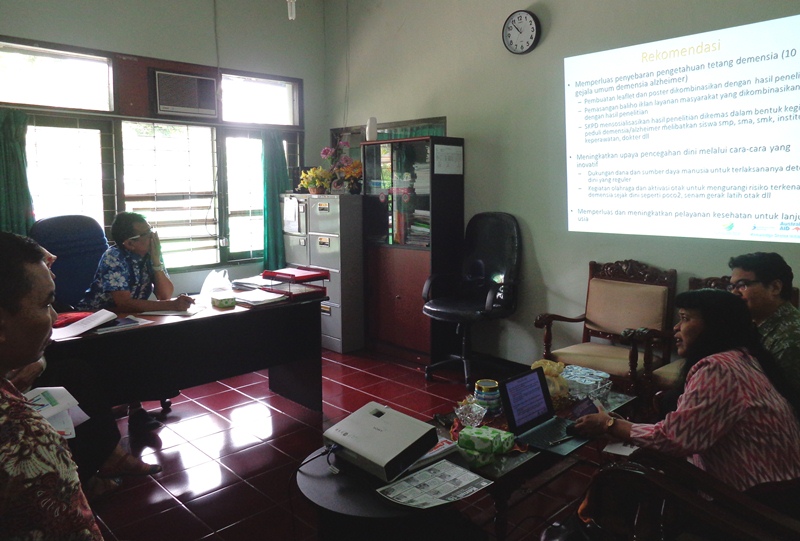
The second target of the Dementia Study dissemination activity in the Special Region of Yogyakarta is the Gunungkidul Regency Government. SurveyMETER sent two formal hearings to the Gunungkidul Regency Government, namely to the Regent and the Health Office. The health office first invited SurveyMETER to conduct an audience.
The hearing with the health office was held on Friday, April 1, 2016, in the Secretary's room of the health office complex of the Gunungkidul regency government. There was attended by the head of the service, Drs. Agus Prihastoro and accompanied by the community service staff Kartini, Ratna Pertiwi, and M. Ali Masudi.
Representing the research team, Dr. Ni Wayan Suriastini M.Phil and Teguh Yudo Wicaksono Ph.D. presented the results study followed by question and answer. The data generally depicted the prevalence of dementia in Gunungkidul Regency and Yogyakarta that has reached 2 to 3 times the global prevalence rate. Based on them, Gunungkidul regency has the highest prevalence of dementia among the 5 regencies/cities in the Special Region of Yogyakarta (DIY).
The head of the health office and other participants generally acknowledge well to the study results. They expect the outcomes are more detailed considering people there are divided into three that respectively have different characters: The Northern, the Central, and the Southern regions. Likewise, the factor of low education level also supports a high prevalence rate. It includes many people who are considered rich, especially if it is based on the area of tenure agricultural land.
"Of all the residents in Gunungkidul, there are only 10% of the productive age group. The rest migrated to the cities. "They will come back here when they are old,” said Pak Kadis. So, the socialization of dementia is important to the community.
Meanwhile, Kartini conveyed that the study results had never been identified before, including those from Susenas or Riskesdas. She also confirmed them and the follow-up needs to be considered. It is necessary to disseminate dementia to the community and families so that they understand the correct life cycle. Unfortunately, the posters or billboards productions for outreach to the public is currently not programmed since it has been prioritizing the dissemination of infectious diseases works.
In the future, the Health Office will seek special socialization on dementia by making leaflets and outreach to puskesmas and posyandu for the elderly. Including campaigns for youth groups or students (SMA and SMP). "For early prevention, what has just been done is the socialization of the elderly polite health center through the Puskesmas, Posbindu, and Posyandu for the elderly since 2015," said Kartini while mentioning that of the 30 health centers in Gunungkidul, only 18 have pioneered to become a community health center for the elderly.
At the end of the event, the health office invited SurveyMETER to present the study of the elderly-friendly health center conducted in 2013. (JF)
Kulon Progo Regency Government Welcomes Dementia Study Recommendations
Friday, 01/04/2016DI Yogyakarta
The Dementia Study in the Special Region of Yogyakarta was conducted independently by SurveyMETER commenced the dissemination stage to stakeholders in the sample districts/cities. The first dissemination through formal hearings was carried out to the Kulon Progo district government, where took place on Thursday, March 31, 2016, at the Glass Building, the complex of district government center Kulon Progo..
The Deputy Regent of Kulon Progo, Drs. H. Sutedjo, welcomed the research team. He was accompanied by the Deputy Director of Wates Hospital (dr. Johannes Witanto), the Assistant District Head for Welfare (Lestaryono, M.Kes), a representative from the Health Service (Ari Tuti U., SKM), and a representative from the Welfare Section of the Kulon Progo Regional Secretary.
It was assigned with presentations of study results and then responses, input, and discussions. The research team leader, Dr. Ni Wayan Suriastini, M.Phil, and research member, Teguh Yudo Wicaksono, Ph.D., presented the study results. It generally shows that the prevalence of dementia in Kulon Progo is 2 to 3 times the global prevalence rate. It has the second-highest rank after Gunungkidul. The Kulon Progo district government through the Deputy Regent and other audience participants responded well to the study results.
“The data from this research is a portrait of Kulon Progo and the Special Region of Yogyakarta in general that must be accepted and addressed. This data is an important input for Kulon Progo, especially the Health Service, district hospital (RSUD), and Public Health Centers throughout Kulon Progo,” said Deputy Regent Tedjo in his response after first expressing his gratitude for conducting this study.
He conveyed the dissemination of dementia is important and calls for implementation to be properly and publicly perceived the existence. So, the negative stigma of society that points out senile disease as a natural symptom may be changed. "We expect the elderly may enjoy a long and healthy life without senile dementia is part of what we will strive for," said Deputy Regent Tedjo.
According to Tedjo, the research triggers further studies to conduct. It is mainly related to some facts and figures from the study results in Kulon Progo are different from other regencies/cities. However, the Kulon Progo district government agrees that efforts to prevent early dementia are very important. “The technical government work units will administer it. The health center as the extension of the service are prohibited to solely waiting for any action but has to fetch the initiative to do, such as by visiting the community by socializing the results of this study, educating the community to know the symptoms of dementia," He said while emphasizing the insistence of the word 'community' attached to the puskesmas.
Since the 2016 RAPBD has been tapped, the planned program of activities related to study recommendations will have been planned by the 2017 budget, 2018, and beyond, but the easiest thing is the Kulon Progo health office immediately followed up on the study recommendations by making a leaflet containing the socialization and campaign of dementia symptoms. The health office would use similar program funds in the 2016 budget that have not been allocated. The socialization material would wait for input from SurveyMETER and the Indonesian Alzheimer's Foundation (ALZI).
At the end of the event, Pak Tedjo, audience participants, and the research team took a group photo. He swiftly displayed the flyer for the campaign "Don't Underestimate of Senile Dementia, Recognize 10 Common Symptoms of Alzheimer's Dementia". (JF)
People are Unfamiliar with the term Alzheimer's Dementia
Tuesday, 01/03/2016Jakarta
The Special Region of Yogyakarta Dementia Study 2015 showed the elderly and the caregiver's level of knowledge in terms of Alzheimer's Dementia was low. The elderly know the term Alzheimer's Dementia only reach 20% while the companion/caregiver is 26%. Hence, It is necessary to spread the term "Alzheimer's Dementia" to afford to improve the prevention of People With Dementia (ODD) starting from the community and must be supported by all stakeholders and society in general.
It was conveyed by Wayan Suriastini on Friday, February 26, 2016, in Jakarta as the researcher of the study in front of the forum "Dialogue on the Development of Health Intelligence Development Profiles in the Regions" organized by the Center for Analysis of Health Determinants (on February 25-27, 2016) Ministry of Health of the Republic of Indonesia.
According to her, the dissemination of the term Alzheimer's dementia is required in order to promulgate the term Alzheimer's dementia to a wider circle of people then increase mutual attention and concern.
She further stated that health is one indicator of the achievement of a prosperous Indonesian society. Various kinds of health problems will appear simultaneously with the increasing age, one of which is cognitive or intellectual disorders. It is caused by a physical decline in the brain. Many terms appear to the disorder with senility whereas in fact the occurrence of physical decline in the brain may be caused by Alzheimer's.
Alzheimer's dementia is a disorder that affects emotions, memory, and decision-making. It often goes undetected, regardless of the symptoms that might be experienced from a young age (early-onset dementia) and early detection can help People with Dementia (ODD) and families to afford to deal with the psycho-social effects of the disease.
The most appropriate and best effort at this time is to prevent disease. It may reduce health costs and burdens for the family. Prevention of disease will run well if promotive efforts can be carried out comprehensively by involving all stakeholders and the community. Many studies state there is an effect of knowledge on disease prevention, as a person's level of knowledge can influence someone in taking action.
Please download the study results presentation materials here
Presentasi Hasil Studi di Internasional Conference on Family Planning
Thursday, 28/01/2016Nusa Dua, Bali
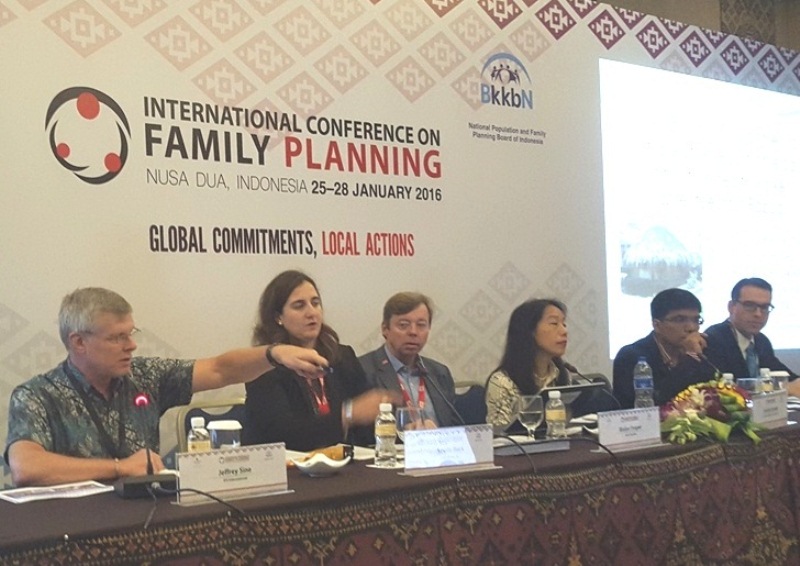
Hasil Studi Pelayanan Tenaga Kesehatan Puskesmas di Papua (Survey of Absenteeism in Health Center of Papua Province) kerja sama SurveyMETER, RTI Internasional dan USAID-Kinerja dipresentasikan dalam Internasional Conference on Family Planning di Nusa Dua, Bali pada 25-28 Januari 2016.
Hasil studi dikemas dalam presentasi dengan judul “Hambatan Kebijakan Operasional Menuju Sekuritas Kontrasepsi: Studi Kasus Ketidakhadiran Petugas Kesehatan Terdepan di Papua”. Presentasi disampaikan tim peneliti pada sesi siang hari ke-3 tanggal 27 Januari 2016.
Studi ini merupakan penelitian terhadap absenteeism(ketidakhadiran) petugas kesehatan pada 50 puskesmas di Provinsi Papua. Studi dilakukan dengan mewawancarai lebih dari 577 petugas kesehatan yang hadir maupun yang tidak hadir pada saat kunjungan tanpa pemberitahuan ke Puskesmas. Pengumpulan data lapangan dilakukan pada Mei-Juni 2014 lalu.
Presentasi cukup mendapatkan perhatian peserta. Misalnya bagaimana bisa tingkat absenteeism di satu kabupaten lebih tinggi dibandingkan dengan kabupaten lainnya. Dalam konferensi ini terungkap bahwa kebijakan oprasional menjadi terhambat karena, salah satunya, adanya perbedaan dalam pemberian insentif.
Selain presentasi tim peneliti berkesempatan memperluas jaringan dan horizon pengetahuan terkait perkembangan keluarga berencana terkini di dunia dengan mengikuti sesi diskusi panel. Salah satu panel mengambil tema “Youth Planary Challenging Old Assumtions, Forging a New Agenda”. Yaitu terkait dengan peranan remaja dan pemuda dalam kesehatan reproduksi dan keluarga berencana. Peserta diskusi panel diantaranya membahas tentang hak pemuda dan remaja untuk mendapatkan pendidikan seksualitas, mengontol fertilitas dan bagaimana menjadikan pemuda bagian dari solusi.
Di antara poin yang disampaikan peserta panel adalah klinik pemerintah dan swasta yang dibentuk untuk ramah remaja agar banyak dimanfaatkan oleh remaja. Klinik harus menerima dengan senang hati setiap remaja atau pemuda yang datang dengan permasalahannya, memberikan penilaian atas kejadian yang dialaminya, serta harus menjaga rahasia mereka.